Guides · Kubernetes & Delivery · GitOps · Kubernetes
Argo CD vs Flux in 2026: Which GitOps Tool Should You Pick?
· 3 min read
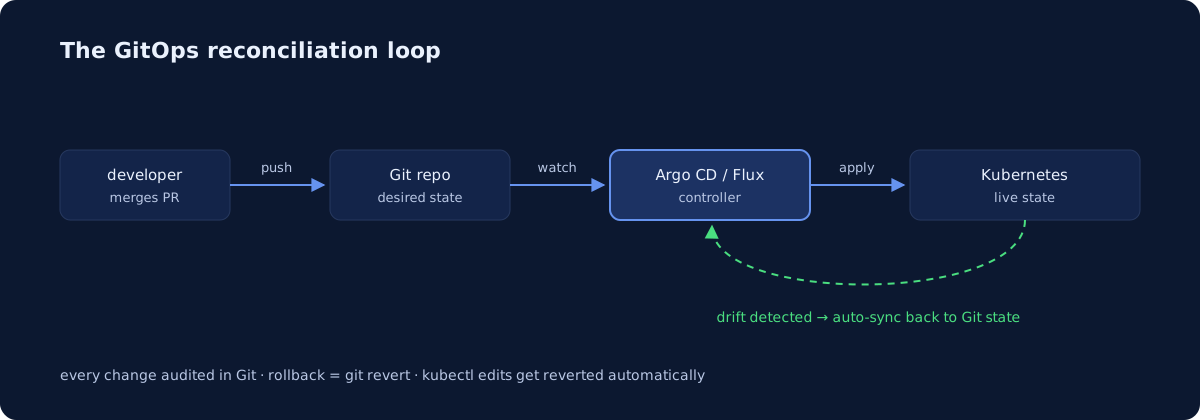
GitOps won. Git as the single source of truth, a controller reconciling the cluster against it, every change auditable and revertible — that’s now the standard deployment model for Kubernetes, and the market question has moved on to which controller: Argo CD or Flux. Both are CNCF-graduated, both production-proven. For a startup picking its first GitOps tool, the differences that matter are practical, not philosophical.
What’s the short answer?
Argo CD for most startups. The web UI is the deciding factor: when a deploy goes sideways at 9pm, “open the dashboard, see exactly which resource is out of sync and why” beats “run flux CLI commands and read controller logs” — especially for product engineers who didn’t set the system up. Flux wins when you want a leaner, headless, building-block toolkit and nobody needs a UI.
Where Argo CD is stronger
- The UI. A live application map — every Deployment, Pod, and Service, its sync state, its health, one-click diff and rollback. This is the feature that makes GitOps adoptable by your whole team rather than the one person who configured it.
- App-of-apps and ApplicationSets. Managing 10–50 services across staging/production from one declarative root is a solved, well-documented pattern.
- RBAC and SSO built in. Read-only access for the team, admin for whoever owns infra, wired to Google/GitHub SSO in an afternoon.
- Sync waves and hooks. Ordered rollouts (migrations before deployments) are first-class.
Where Flux is stronger
- Footprint and composability. A set of small controllers rather than one platform. If you’re embedding GitOps into your own tooling, Flux is the cleaner primitive.
- Native Helm releases. Flux’s HelmRelease actually runs
helm installunder the hood, preserving hooks and release history. Argo CD templates charts and applies the output — fine in practice, but purists notice. - Image automation. Auto-committing new image tags back to Git is built into Flux; with Argo CD it’s a separate project (Argo CD Image Updater).
What about multi-cluster?
Both handle it. Argo CD manages remote clusters from one control plane with one dashboard across all of them; Flux runs per-cluster and aggregates through Git structure. At one-to-three clusters — where most startups live — either is fine, and the Argo CD single-pane view is again the more team-friendly default.
Does the choice lock you in?
Less than you’d fear. Both consume plain manifests, Helm charts, and Kustomize overlays from Git. If your repo structure is clean, migrating between them is days of work, not months. The lock-in lives in your Git layout, not the controller — which is why getting the repo structure right on day one matters more than the tool choice.
The setup that works at startup scale
What we deploy as the default: Argo CD, app-of-apps, two environments, sync waves for migrations, SSO, and Slack notifications on sync failures — reconciling a repo your team already knows how to use. It’s part of every Cloud Launch build and detailed on our Argo CD page. Pipelines feeding it are usually GitHub Actions: CI builds and pushes the image, bumps the tag in Git, and Argo CD does the rest.
If you already run GitOps and it feels harder than this — sync loops nobody trusts, secrets handled by hand, drift between environments — that’s exactly the kind of finding a $1,900 infrastructure audit turns into a fix list with a money-back guarantee.
Newsletter
One practical DevOps guide a week
Real numbers, honest trade-offs, no vendor fog — same as everything here. Unsubscribe anytime.