Guides · Kubernetes & Delivery · reliability · architecture · disaster-recovery
Does Your Startup Actually Need Multi-Region?
· 7 min read
Almost certainly not yet — and the work that would actually keep you online is cheaper, faster, and less glamorous than a second region.
This is worth saying plainly because 2026 has made cloud reliability a board-level topic again. Forrester’s Lee Sustar predicted that hyperscalers prioritising GPU-centric AI capacity while “aging infrastructure falters under growing complexity” would produce “at least two major multiday outages in 2026.” Every such outage produces a wave of “you should have been multi-region” commentary aimed at companies for whom that is the wrong lesson.
If you are a funded startup with 5-25 engineers, the honest answer is that a second region is one of the most expensive ways to buy availability you can pick, and it is rarely the constraint that is actually hurting you.
What actually took you down last time?
Ask any small team for their last five incidents. The list is almost always some combination of a bad deploy, a migration that locked a table, an expired certificate, a dependency that changed behaviour, a disk filling up, a misconfigured security group, or a third-party API having a bad day.
A full regional failure is usually not on that list. Multi-region addresses exactly one of those failure modes and none of the others. Worse, it makes several of them more likely, because a bad deploy is now a bad deploy in two places and a schema migration has to be correct across an asynchronous replica.
This is the core of the argument. Availability is not one number you buy — it is the product of everything that can break. Spending your entire reliability budget on the rarest failure mode while deploys still go out untested is optimising the wrong term.
If you don’t have a clear picture of your own last five incidents, that is the first thing to fix, and our 20 signs your infrastructure needs an audit is a faster read than any architecture decision.
What multi-region actually costs
Three costs, and only the first is obvious.
Money. Roughly double the compute and database footprint, plus cross-region data transfer billed per gigabyte. Replication traffic is continuous, so this is not a rounding error — it is a recurring line that grows with your data. If your bill is already unclear, why is my AWS bill so high covers where it tends to hide.
Complexity, permanently. Every deploy, migration, and incident now has two of everything. Schema changes must be compatible across an asynchronous replica. Feature flags need to agree in both places. Your on-call engineer has to reason about which region served a given request before they can read a log. This tax is paid on every change, not only during outages.
A distributed-systems problem you now own. Availability zones sit a few milliseconds apart, so you can run synchronously across them. Regions are geographically distant, so replication is asynchronous, and you must choose: accept write latency, or accept that a failover can lose the last few seconds of writes. There is no configuration flag that removes that choice — it is physics, and it becomes your product’s problem.
The resilience ladder
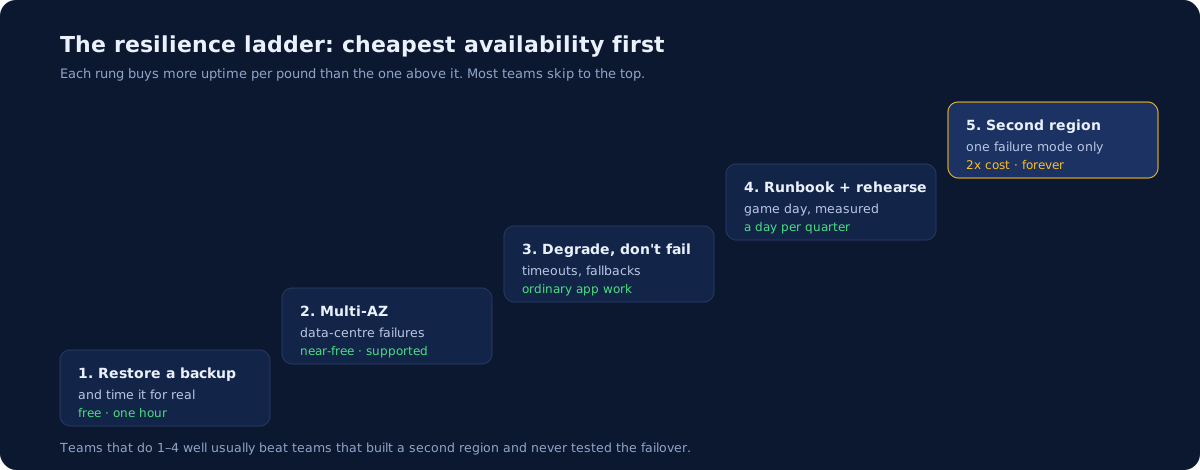
Work these in order. Each rung is cheaper than the one after it and buys more availability than teams expect.
1. Restore a backup and time it. Not “do we have backups” — actually restore one into a scratch environment and measure how long it takes. Most teams discover their real recovery time is many hours longer than assumed, or that a backup has been silently failing. This is the highest-value hour in reliability engineering and it costs nothing.
2. Spread across availability zones. Multi-AZ is close to free, well supported by managed databases, and covers the data-centre-level failures that are far more common than whole-region loss. If you’re on managed Kubernetes, spread node groups across AZs and make sure your database is actually multi-AZ rather than nominally so. Our EKS vs GKE vs AKS comparison covers the defaults each provider gives a small team.
3. Degrade instead of failing. When search is down, the site should still load without search. When the recommendation service times out, show a static list. Most user-visible “outages” at small companies are one non-critical dependency taking the whole page down with it. Timeouts, circuit breakers, and sensible fallbacks are ordinary application work and they convert hard failures into soft ones.
4. Write the runbook, then rehearse it. A documented, practised procedure for “the database is gone” is worth more than an untested automated failover. Run a game day: pick a dependency, break it in staging, and time how long it takes to notice and recover. The gap between what people assume and what happens is where availability is actually lost.
5. Then, and only then, consider a second region.
Teams that do the first four well routinely have better real-world availability than teams that built multi-region and never tested a failover.
The single-region dependencies you don’t know you have
If you do go multi-region, this is the part that catches people: your compute being multi-region does not make your system multi-region.
Audit these before assuming a failover works:
- Provider control planes. Some services are globally coordinated with a home region. During large incidents the data plane often keeps serving while the control plane — the part that lets you launch, scale, or change things — degrades. You may be unable to act even where you can still serve.
- DNS and CDN configuration. Frequently a global service with its own single points of failure, and the thing your failover depends on most.
- Identity and auth. If sessions or tokens are validated in one region, everything else is decorative.
- Your CI/CD and secrets store. If you cannot deploy during an incident, you cannot fix anything.
- Third-party APIs. Payments, email, analytics. Your second region does not give your payment provider a second region.
The pattern worth internalising: incidents cascade through configuration and control planes far more often than through raw compute failure. A change in one place propagating globally is a much more common shape than a region vanishing.
When multi-region genuinely is the answer
Three cases, and they are all business cases rather than engineering ones:
- A contractual RTO or RPO you cannot otherwise meet. An enterprise customer’s agreement specifies recovery objectives that a single-region restore cannot satisfy. This is the most common legitimate trigger, and it usually arrives with the deal that pays for it.
- Regulatory or data-residency requirements that already force a second region — at which point you are running two regions anyway and should design them deliberately.
- The revenue maths clears. An hour of downtime costs more than the annual cost of the second region, and you have already done the four cheaper rungs. If you have not done those, the maths is not really clearing — you are just buying the expensive option first.
Note what is not on this list: a competitor announced it, an outage was in the news, or an investor asked. Those are real pressures, and the answer to them is a written resilience plan showing what you have done and when multi-region triggers — not an architecture you cannot operate.
How to know where you stand
Pick your most important user journey — signup, checkout, whatever pays you — and answer three questions for each dependency in it: what happens if this is slow, what happens if it is gone, and how would we know? Most teams find two or three answers they don’t like, and fixing those is a fortnight of work rather than a re-architecture.
Then test it. An untested resilience plan is a document, not a capability.
Getting a second opinion
Deciding between “we’re fine” and “we need a second region” is exactly the kind of call that benefits from someone who has seen both go wrong — and it is a decision worth getting right before you commit to doubling your infrastructure. Our infrastructure audit maps your actual failure modes and recovery times, and if the answer is that you don’t need multi-region, we will say so. If you’d rather start free, the two-minute health check asks the backup and monitoring questions that predict most of this.
Forrester’s 2026 outage prediction is quoted from TechTarget’s January 2026 report. Specific incident statistics circulating about 2026 outages could not be traced to a primary source and are deliberately not cited here.
Common questions
Does my startup need multi-region?
Almost certainly not yet. Multi-region roughly doubles infrastructure cost and adds permanent complexity to every deploy, and it only protects against one failure mode - a whole region going down - which is rarer than the failures that actually take startups offline. Tested backups, multi-AZ, and a rehearsed runbook buy far more availability per pound spent.
What is the difference between multi-AZ and multi-region?
Availability zones are separate data centres within one region, usually a few milliseconds apart, so you can run synchronously across them with little complexity or cost. Regions are geographically distant, so cross-region replication is asynchronous and forces you to choose between data loss and latency. Multi-AZ is close to free; multi-region is an architecture decision.
How much does multi-region cost?
Budget for roughly double your compute and database footprint, plus cross-region data transfer, which is billed per gigabyte and is often the surprise line. The larger cost is ongoing: every schema migration, deploy, and incident now has two of everything, which taxes a small team on every change rather than only during an outage.
What should a startup do instead of going multi-region?
Work the cheaper rungs first. Restore a backup and time it. Spread across availability zones. Make the app degrade rather than fail when a dependency is down. Write and rehearse a runbook. Most teams that do these four things well have better real-world availability than a team that built multi-region and never tested a failover.
Newsletter
One practical DevOps guide a week
Real numbers, honest trade-offs, no vendor fog — same as everything here. Unsubscribe anytime.