Guides · Compliance & Certifications · cis-benchmarks · cloud-security · hardening
CIS Benchmarks: The Free Hardening Baseline for Cloud
· 5 min read
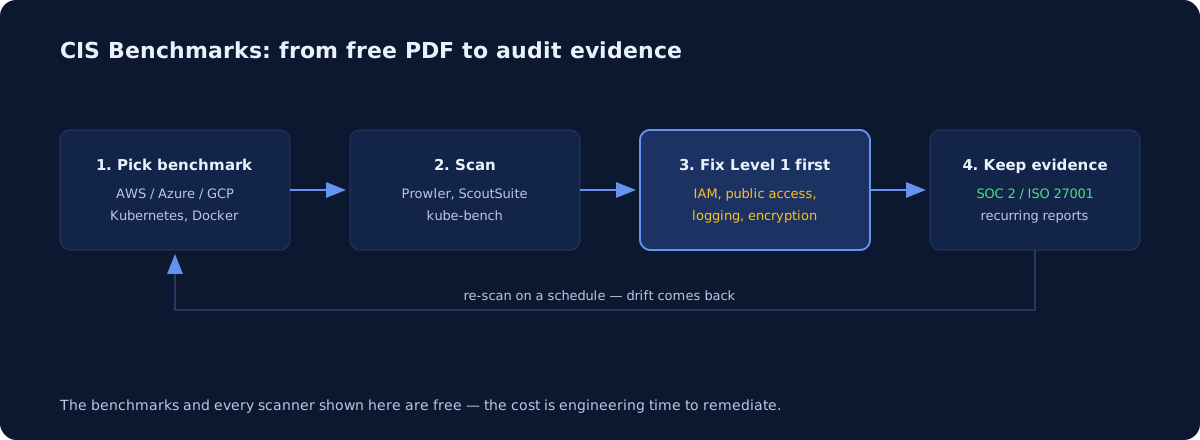
CIS Benchmarks are free, consensus-built configuration standards from the Center for Internet Security that tell you exactly how to harden a specific technology — AWS, Azure, GCP, Kubernetes, Docker, and dozens more. They are the closest thing cloud security has to a universal default answer: free to download, scannable with open-source tools, and accepted by SOC 2 and ISO 27001 auditors as a hardening baseline. If your startup has no security baseline yet, CIS is where we tell clients to start, because the cost is zero and the first scan usually takes an afternoon.
What exactly is a CIS Benchmark?
A CIS Benchmark is a versioned document of prescriptive configuration recommendations — per CIS, they cover more than 25 vendor product families across 100+ configuration guides, all free to download. Each recommendation states what to configure, why it matters, and how to audit it, which is what makes benchmarks scannable by tooling rather than just readable by humans.
Two details matter for planning. First, recommendations are split into Level 1 (baseline hardening with minimal operational impact) and Level 2 (defense-in-depth settings that can break workflows — think stricter network and auth constraints). Second, benchmarks are versioned and revised: the AWS Foundations Benchmark, for example, has moved through v1.2.0, v1.4.0, v3.0.0, and v5.0.0, and newer revisions drop stale requirements like password-complexity rules while adding modern ones like requiring IMDSv2 on EC2 instances (per the AWS Security Hub docs, which track all four versions).
Which benchmark applies to my stack?
Almost certainly several at once, and that’s fine — start with the Foundations benchmark for your cloud, then add the container ones. The main flavors a startup cares about:
| Benchmark | Covers | Typical scanner |
|---|---|---|
| AWS Foundations | IAM, CloudTrail, S3, VPC, RDS basics | Prowler, Security Hub |
| Azure Foundations | Entra ID, storage, logging, network | Prowler, ScoutSuite |
| GCP Foundation | IAM, logging, buckets, networking | Prowler, ScoutSuite |
| Kubernetes (+ EKS/GKE/AKS variants) | API server, kubelet, RBAC, policies | kube-bench |
| Docker | Daemon config, image and runtime hardening | docker-bench-security |
Note the managed-Kubernetes variants: on EKS, GKE, or AKS the provider runs the control plane, so the dedicated EKS/GKE/AKS benchmarks skip the master-node checks you can’t touch and focus on what you can — node config, RBAC, and workload settings.
How do I actually scan against CIS?
With free, open-source tools — no vendor purchase required for a first pass. Prowler (Apache-2.0) is the workhorse: at time of writing its repo lists 639 checks for AWS, 191 for Azure, 109 for GCP, and 92 for Kubernetes, with results mappable to CIS, SOC 2, ISO 27001, PCI-DSS, and HIPAA frameworks. kube-bench (Aqua Security, Apache-2.0) runs as a Kubernetes job inside the cluster, auto-detects your version, and reports CIS Kubernetes Benchmark results in the pod logs, with job manifests for EKS, GKE, and AKS. ScoutSuite (NCC Group, GPL-2.0) gives a browsable multi-cloud posture report across AWS, Azure, and GCP.
If you’re AWS-heavy, note that AWS Security Hub ships CIS AWS Foundations v3.0.0 and v5.0.0 as a managed standard, CIS-certified at both Level 1 and Level 2 — useful when you want continuous checks without running Prowler on a schedule yourself. Azure and GCP have rough equivalents in Defender for Cloud and Security Command Center.
The honest caveat: a first scan on a two-year-old account commonly returns hundreds of findings. The scan is the easy part. Triage is the work — which is exactly the shape of our infrastructure audit, and you can see how we present findings in a sample audit report.
Which findings should I fix first?
Fix the failures that are actually attack paths, not the ones at the top of the report. Scanners sort by check ID, not by risk to your environment. The pattern we recommend clients follow:
- Identity first: root/owner accounts without MFA, long-lived access keys, users with directly attached admin policies. These are the findings behind most real cloud breaches.
- Public exposure second: S3/storage buckets without public-access blocks, security groups open to 0.0.0.0/0 on admin ports, databases flagged publicly accessible.
- Logging third: CloudTrail (or the Azure/GCP equivalent) enabled, multi-region, tamper-evident. Not a direct attack path, but without it you can’t investigate anything, and every auditor asks.
- Encryption and the long tail last: at-rest encryption defaults, key rotation, then the Level 2 items — deliberately, because Level 2 settings can break things.
A reasonable near-term target is clean on Level 1 for your primary cloud, with documented, accepted exceptions for the rest. One hundred percent is not the goal; a defensible, shrinking findings list is.
How does CIS map into SOC 2 and ISO 27001 evidence?
CIS Benchmarks are not a certification — there is no “CIS certified” report to hand a customer — but they slot directly into the frameworks buyers do ask for. SOC 2’s security criteria and ISO 27001’s Annex A both expect you to have a hardening standard and to monitor against it; adopting CIS is that standard, and recurring Prowler or kube-bench reports are the monitoring evidence. Prowler will even output findings tagged against SOC 2 and ISO 27001 frameworks, and compliance platforms lean on the same idea — see how that works in practice in our posts on automating SOC 2 evidence with Vanta and Drata and the SOC 2 infrastructure checklist. Running ISO instead? The mapping logic is the same — our ISO 27001 infrastructure checklist walks Annex A in practice.
The move that pays off: don’t run CIS scanning as a one-off. Schedule it, alert on regressions, and archive the reports. When the audit arrives, you have a year of evidence instead of a scramble. (This is engineering guidance, not legal or audit advice — your auditor has the final word on what counts as evidence.)
If you’d rather have a practitioner run the first scan, triage the findings against your actual risk, and leave you a prioritized fix list, that’s the core of ByteDel’s audit offering — AWS, GCP, or Azure.
Newsletter
One practical DevOps guide a week
Real numbers, honest trade-offs, no vendor fog — same as everything here. Unsubscribe anytime.