Guides · Compliance & Certifications · soc2 · roadmap
The Startup Compliance Roadmap: Which Cert at Which Stage
· 5 min read
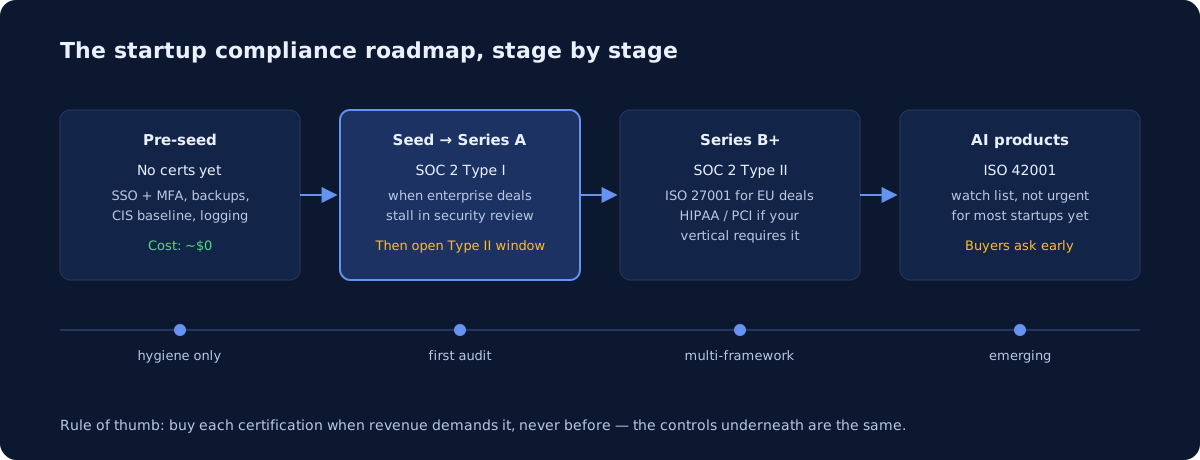
The roadmap in one paragraph: at pre-seed, buy nothing — just run good security hygiene so future audits are cheap. Between seed and Series A, get SOC 2 Type I the moment an enterprise deal stalls in security review, and open your Type II window the same month. At Series B and beyond, maintain SOC 2 Type II, add ISO 27001 when EU pipeline appears, and layer vertical requirements — HIPAA, PCI DSS — only if your product touches health data or card payments. If you sell an AI product, put ISO 42001 on the watch list. Certifications are sales tools: buy each one when revenue demands it, never before.
What compliance does a pre-seed startup need?
None — no auditor, no platform subscription, no framework. What you need is the hygiene that makes a future audit a formality instead of a rebuild: SSO and MFA everywhere, least-privilege IAM, separate prod and dev environments, encrypted storage, automated backups you have actually restored, and centralized logs. The CIS Benchmarks give you a free, auditor-recognized hardening baseline for AWS, GCP, or Azure, and our SOC 2 infrastructure checklist doubles as a hygiene list even if the audit is years away. Do this at pre-seed and later audit readiness is largely a paperwork exercise; skip it and the readiness phase turns into an untangling project — shared root credentials and all.
One regulation applies from day one regardless of stage: if you have EU users, GDPR is law, not a certificate — the infrastructure side of GDPR (data residency, deletion workflows, encryption) is cheapest to build early.
When should a startup get SOC 2?
When a real enterprise deal stalls on it — typically between seed and Series A — and not a quarter sooner. The trigger is concrete: a security questionnaire lands, or a prospect’s procurement team says “send your SOC 2.” At that point get Type I (a point-in-time report you can finish in weeks) to unblock the deal, and declare the start of your Type II observation window the same month so the slower report is already cooking. The full trade-off is in our Type I vs Type II breakdown.
Two things make this fast instead of painful. First, a compliance platform — Vanta or Drata wired into your infrastructure — automates evidence collection. Second, the infrastructure has to genuinely satisfy the controls; the mapping from SOC 2 controls to real infrastructure changes is where most of the engineering time goes. That remediation is exactly what ByteDel’s fixed-price SOC 2-Ready Infrastructure package covers: $6,900, 3–4 weeks, scoped against your platform’s failing checks on AWS, GCP, or Azure.
If a buyer asks for “SOC 1” or “SOC 3” instead, that’s usually a vocabulary mix-up worth decoding before you spend money — see SOC 1 vs SOC 2 vs SOC 3.
What changes at Series B and beyond?
The bar moves from “prove controls exist” to “prove they operate, everywhere you sell.” Concretely:
- SOC 2 Type II becomes table stakes. Large-enterprise security teams increasingly won’t accept Type I alone; Type II renews annually and fails on neglect (skipped access reviews, untested restores), not design.
- ISO 27001 when EU or APAC enterprise pipeline appears. The control overlap with SOC 2 is roughly 80% per the AICPA’s mapping, so it’s mostly an ISMS documentation layer on controls you already run — the ISO 27001 vs SOC 2 decision and the Annex A infrastructure checklist cover the sequencing.
- Vertical requirements as your product demands. Handling PHI means HIPAA — a regulation with no official certification, satisfied through BAAs and documented safeguards. Touching card data means PCI DSS, where smart scoping (letting Stripe or Adyen hold the card data) keeps most startups in cheap self-assessment territory.
Do AI products need ISO 42001?
Not yet, for most — but watch it. ISO/IEC 42001, published in December 2023, is the first certifiable management-system standard for AI, and enterprise buyers of AI products have started asking about it in questionnaires the way they asked about SOC 2 a decade ago. Our read: if AI is your core product and you sell to large enterprises, budget for it at Series B alongside ISO 27001 (the management-system machinery is shared); otherwise a good answer on your AI tooling’s data handling covers today’s questionnaires. Full detail in our ISO 42001 explainer.
What does each certification cost, and how long does it take?
Published ranges from Vanta and Secureframe:
| Certification | Typical cost | Timeline | Renewal |
|---|---|---|---|
| SOC 2 Type I | $10–20K audit + platform | Weeks to a quarter | Superseded by Type II |
| SOC 2 Type II | $30–60K audit | 3–12 month observation window | Annual |
| ISO 27001 | ~$14–16K Stage 1+2 audits (per Vanta); $6–40K+ all-in | ~6 months to certificate | 3-year cert + annual surveillance (~$6–7.5K) |
| HIPAA | No certification — assessment + BAAs | Ongoing obligation | Continuous |
| PCI DSS (SAQ) | Low if scope is small; QSA audits cost far more | Weeks if pre-scoped | Annual |
Add a compliance platform at roughly $8–20K/year, and note the largest cost in every row is the one that never appears on an invoice: engineering time to make the controls true.
What’s the one mistake to avoid?
Buying certifications out of order — an ISO 27001 nobody asked for, or SOC 2 at pre-seed with no enterprise pipeline. Every framework above audits substantially the same infrastructure, so the durable investment is the platform underneath: build the controls once, then attach whichever badge each market demands. That’s the engagement shape we run — the $6,900 SOC 2 package for the readiness push, then a DevOps retainer to keep checks green through Type II and beyond; see pricing for both.
This is engineering guidance, not legal or audit advice — confirm scope and requirements with your auditor or counsel.
Newsletter
One practical DevOps guide a week
Real numbers, honest trade-offs, no vendor fog — same as everything here. Unsubscribe anytime.