Guides · Compliance & Certifications · soc2 · audits
SOC 1 vs SOC 2 vs SOC 3: What Buyers Actually Ask For
· 5 min read
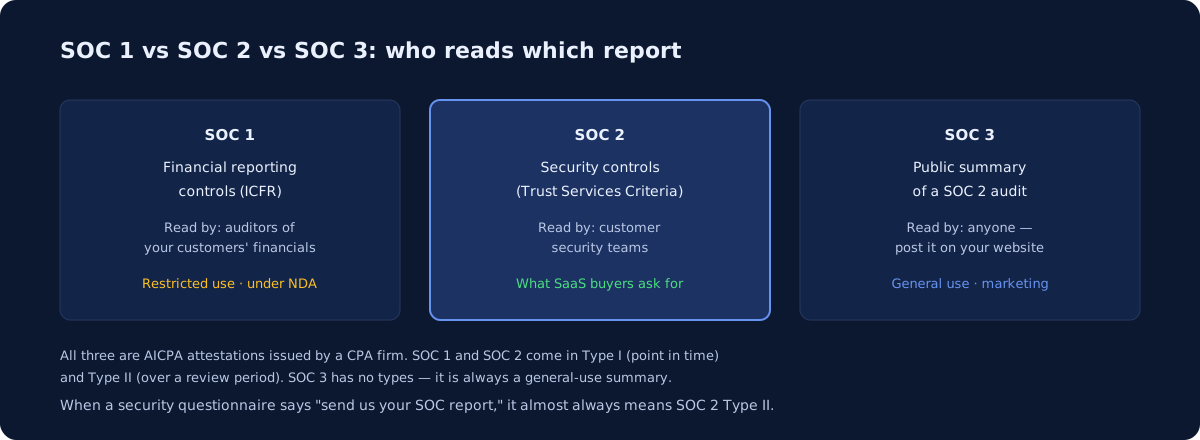
SOC 1, SOC 2, and SOC 3 are three different AICPA attestation reports, and they answer different questions. SOC 1 covers controls relevant to your customers’ financial reporting. SOC 2 covers security and related controls against the Trust Services Criteria — it’s what SaaS buyers almost always mean when a questionnaire says “send us your SOC report.” SOC 3 is a public, general-use summary of a SOC 2 audit that you can post on your website. If a customer’s security team is asking, they want a SOC 2 Type II.
What is a SOC 1 report and who asks for it?
SOC 1 is about internal controls over financial reporting (ICFR). It exists so that when your service can affect a customer’s financial statements — you process their payroll, payments, billing, or ledger data — their financial auditors can rely on your controls without auditing your systems themselves. It’s requested by finance and audit teams, not security teams.
Concretely: payroll processors, payment platforms, claims administrators, and fund-accounting services get asked for SOC 1. A typical B2B SaaS product that stores customer data but doesn’t touch anyone’s books rarely needs one. Like SOC 2, it comes in Type I and Type II variants and is a restricted-use report — shared with customers and their auditors, usually under NDA, not published.
If you’re a startup and someone asks for your SOC 1, first check whether they actually mean SOC 2. The two terms get swapped constantly on procurement questionnaires, and a quick clarifying email saves you from scoping the wrong audit.
What is a SOC 2 report and why is it the one buyers want?
SOC 2 is the security attestation. An independent CPA firm evaluates your controls against the AICPA’s Trust Services Criteria — five categories: Security (mandatory), Availability, Processing Integrity, Confidentiality, and Privacy. Most startups scope Security plus Availability, sometimes Confidentiality, and skip the rest until a customer demands them.
This is the report enterprise security reviews are built around. When a prospect’s vendor-risk process asks for “your SOC,” “your audit report,” or “your Type II,” they mean SOC 2 Type II: an auditor’s opinion that your controls not only existed on paper but operated effectively over a review period, typically 3–12 months. The Type I vs Type II distinction matters enough for deals that we wrote it up separately in SOC 2 Type I vs Type II.
SOC 2 reports are also restricted-use: you share them under NDA through a trust portal or on request, and the report contains real detail about your architecture and control exceptions. That restriction is exactly the gap SOC 3 fills.
What is SOC 3 and do you need one?
SOC 3 is a general-use summary of a SOC 2 examination. Same auditor, same Trust Services Criteria, same review period — but the report strips out the detailed control descriptions and test results, leaving a short document you can hand to anyone or post publicly. Large cloud providers publish SOC 3 reports as downloadable PDFs precisely because they can’t NDA the whole internet.
You cannot get a SOC 3 instead of a SOC 2. It’s derived from a SOC 2 Type II engagement, usually offered by the audit firm as an inexpensive add-on. For a 5–25 engineer startup, a SOC 3 is a nice-to-have marketing asset — a trust-page badge with substance behind it — but no buyer accepts it as a substitute for the full SOC 2 report during vendor review.
How do the three reports compare side by side?
| SOC 1 | SOC 2 | SOC 3 | |
|---|---|---|---|
| Subject | Financial reporting controls (ICFR) | Security via Trust Services Criteria | Summary of SOC 2 |
| Audience | Customers’ financial auditors | Customer security teams | General public |
| Distribution | Restricted (NDA) | Restricted (NDA) | Public |
| Types | Type I and II | Type I and II | No types |
| Who needs it | Payroll, payments, billing services | Nearly every B2B SaaS | Optional add-on |
All three are attestations under the AICPA’s SSAE 18 standards, issued by licensed CPA firms — none of them is a “certification” in the ISO sense, though everyone talks about them that way. (This is engineering guidance, not legal or audit advice — scope the actual engagement with your auditor.)
Which report should your startup get first?
For almost every B2B SaaS startup: SOC 2 Type II, scoped to Security and Availability. Get a Type I first only if a deal is blocked and you need paper in weeks rather than months. Add SOC 1 only if your product sits in your customers’ financial-reporting path, and bolt on SOC 3 later if you want a public artifact. Where SOC 2 fits relative to ISO 27001, HIPAA, and the rest is a sequencing question we cover in the startup compliance roadmap.
The audit itself is the smaller half of the work — the bigger half is infrastructure that produces evidence continuously: access reviews, encryption, logging, change management. Our SOC 2 infrastructure checklist walks the technical side, and platforms like Vanta and Drata automate much of the evidence collection (we compared them here).
If you’re staring down a security questionnaire without a platform team, that’s the exact gap ByteDel fills: we build SOC 2-ready infrastructure on AWS, GCP, or Azure as a fixed-scope engagement — see SOC 2 infrastructure and pricing for how we package it.
Newsletter
One practical DevOps guide a week
Real numbers, honest trade-offs, no vendor fog — same as everything here. Unsubscribe anytime.