Guides · Compliance & Certifications · soc2 · vanta · drata
Automating SOC 2 Evidence: Vanta, Drata, and Your Infra
· 5 min read
Vanta and Drata automate the collection of SOC 2 evidence, not the creation of a compliant infrastructure. Both platforms connect to your cloud accounts with read-only integrations, run automated tests against what they find, and package passing results as evidence for your auditor. That means the platform is only as green as your infrastructure actually is: if RDS encryption is off or MFA isn’t enforced, no amount of dashboard configuration fixes the failing check. The tooling is worth buying — the infra work behind it is where audits are won.
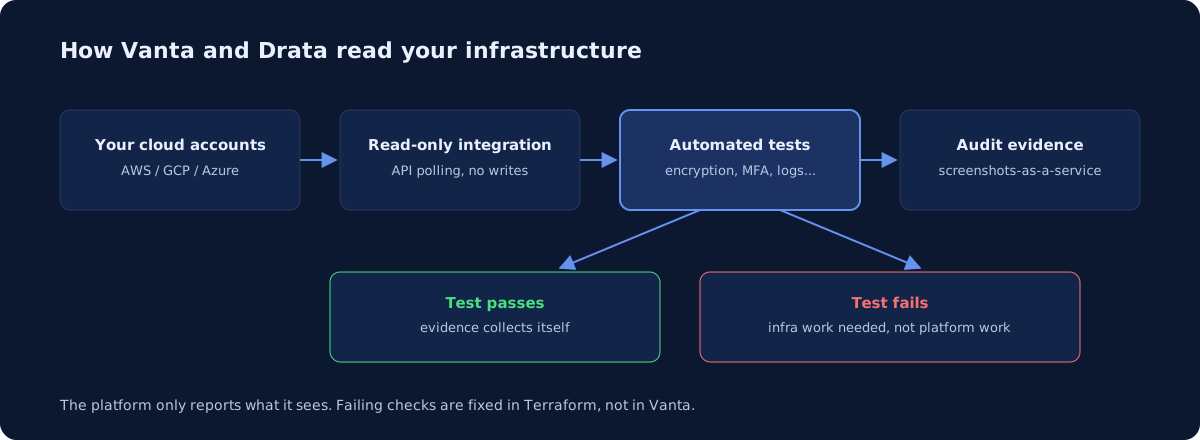
What do Vanta and Drata actually automate?
They automate evidence collection and continuous monitoring — the part of SOC 2 that used to mean quarterly screenshot marathons. Vanta advertises 400+ integrations and hourly automated tests; its AWS integration alone monitors 40+ resource types with 100+ pre-built tests, per Vanta’s own integration docs. Drata takes the same approach across SOC 2, ISO 27001, HIPAA, PCI DSS, and other frameworks, and now serves 8,500+ customers per its site.
Concretely, the platforms handle:
- Configuration reads: encryption settings, public access flags, logging status, IAM policies, pulled continuously via cloud APIs.
- Personnel workflows: onboarding checklists, policy acceptance, security training tracking, background-check status.
- Vendor and access reviews: prompted on a schedule, with the evidence trail captured automatically.
- Audit packaging: passing tests become timestamped evidence your auditor reviews in the platform instead of in a shared drive.
Which platform you pick matters less than most founders think. Both cover the SOC 2 common criteria well; pricing, auditor relationships, and which of your existing tools they integrate with are the real deciding factors. Where teams get stuck is the same on either: the red checks.
Which checks fail most often, and what’s the infra fix?
The failing checks cluster around a predictable set of cloud misconfigurations — the same ones we cover in our SOC 2 infrastructure checklist. Each one is fixed in your cloud provider (ideally via Terraform), not in the compliance platform.
| Failing check | Why it fails | The infra fix |
|---|---|---|
| Encryption at rest | Databases/volumes created before anyone cared | Enable KMS/CMK encryption on RDS, EBS, S3, disks; migrate legacy resources (often a snapshot-restore) |
| MFA enforced for all users | Console users without MFA; root access keys exist | Enforce MFA in your IdP and IAM policy; delete root keys entirely |
| Audit logging enabled | CloudTrail/Cloud Audit Logs/Activity Log missing or partial | Org-wide trail to a locked, versioned bucket in all regions |
| Backups configured | No automated snapshots, or no retention policy | Automated backups with defined retention, plus point-in-time recovery on databases |
| No public storage buckets | One forgotten bucket with public ACLs | Account-level public access block; exceptions documented |
| Vulnerability SLAs met | Scanner findings sit untriaged past the SLA | Wire scanner output to a ticket queue with owners; patch cadence |
| Access removed on offboarding | Cloud accounts outlive the employee | Route all access through SSO/IdP so one deactivation kills everything |
Two things about this table. First, the fixes are boring, well-understood engineering — this is exactly why we map every control to a concrete change in SOC 2 controls mapped to real infrastructure. Second, doing them in Terraform rather than by hand matters for Type II: the platform re-tests continuously through your entire observation window, so a fix that quietly regresses (someone clicks a new unencrypted database into existence) becomes a failed test mid-audit. Codified infrastructure with policy checks in CI is how the checks stay green — a distinction that matters more for Type II than Type I.
What can’t the platforms collect for you?
Anything that lives outside an API. The integrations read configuration state; they can’t read intent, architecture, or process. Expect to produce these yourself:
- Network architecture evidence — segmentation, private subnets for databases, restricted security groups. Tests catch the obvious (public SSH), not whether your architecture is sane.
- Incident response reality — the platform tracks that a policy exists and was acknowledged, not that anyone can execute it. Auditors increasingly ask for a tabletop exercise or a real incident postmortem.
- Change management — you need an actual PR-review-and-CI pipeline producing the trail; the platform just verifies branch protection is on.
- Disaster recovery testing — a backup existing and a backup restoring are different pieces of evidence. Restore tests are on you.
This is engineering guidance, not legal advice — your auditor has the final word on what evidence satisfies which criterion.
How do you get to green before the audit window opens?
Fix the infrastructure first, then connect the platform — or connect it early and treat the red checks as your work queue, which is what we recommend. Either way, budget the infra remediation as a project, not a side task: encryption migrations and SSO rollouts have real lead time, and your Type II observation window shouldn’t start until they’re done. Sequencing this against fundraising and sales deadlines is most of the game — our startup compliance roadmap covers when to start.
This is exactly the gap ByteDel’s SOC 2 infrastructure package fills: we do the cloud-side remediation — AWS, GCP, or Azure — in Terraform, wired to whichever platform you chose, and we guarantee the infrastructure-level checks pass. You buy Vanta or Drata for the evidence conveyor belt; you bring in an engineer for the machine it’s attached to. Pricing for the audit and packages is here if your observation window is already looming.
Newsletter
One practical DevOps guide a week
Real numbers, honest trade-offs, no vendor fog — same as everything here. Unsubscribe anytime.