Guides · Hiring & Strategy · Pricing · Buyer guide
How Much Does a Fractional DevOps Engineer Cost in 2026?
· 6 min read
Published fractional DevOps retainers in 2026 cluster between $2,900 and $5,000 a month for one senior engineer. InstaDevOps prints $2,999 and $4,999 on its site; ours at ByteDel is $2,900 flat; most other providers quote on request. Step up to a dedicated engineer with Kubernetes ownership and SquareOps’ 2026 consulting pricing guide puts the band at $5,000–10,000/month, while InfraZen’s published rate card puts senior-led boutiques and staffed SRE cover at $8,000–30,000/month. Hourly is the other common shape: $40–150/hour on Upwork, and $220–300+/hour for senior US consultants per SquareOps. If you are still weighing whether the model fits at all, our complete guide to fractional DevOps covers that first.
What does each price band actually buy?
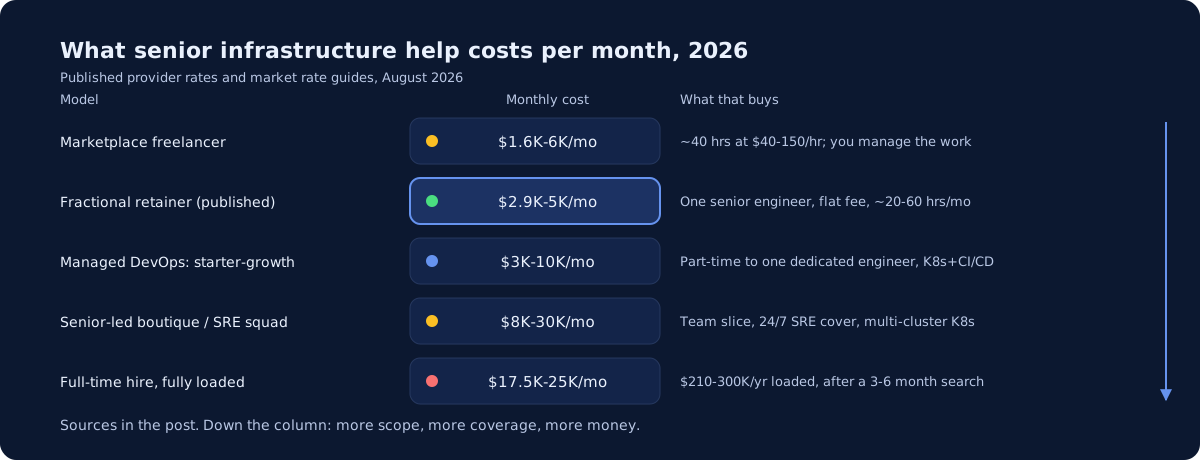
These aren’t the same product at different prices — they buy different shapes of help. Below roughly $3K/month you’re buying hours you have to direct. Between $3K and $5K you’re buying one senior person’s ongoing ownership. Above $8K you’re buying team capacity and contractual coverage.
| Band | Typical monthly | What it buys | Where the number comes from |
|---|---|---|---|
| Marketplace freelancer | $1,600–6,000 | ~40 hrs/mo of hands; you scope and review | Upwork: $40–150/hr |
| Fractional retainer | $2,900–5,000 | One named senior engineer, flat fee, ongoing ownership | InstaDevOps ($2,999/$4,999), ByteDel ($2,900) |
| Managed DevOps, dedicated | $5,000–10,000 | One dedicated engineer, full CI/CD, Kubernetes | SquareOps “Growth” tier |
| SRE squad / senior boutique | $8,000–30,000 | 2–3 engineers, 24/7 SRE, multi-cluster | InfraZen; SquareOps “Scale” $10–25K |
| Full-time hire, loaded | $17,500–25,000 | 160 hrs/mo, after a 3–6 month search | $210–300K/yr fully loaded |
Note how few providers publish anything. Checking in August 2026: InstaDevOps publishes tiers; MeteorOps publishes its model (an hours bank from 40 hours, billed hourly, explicitly no flat retainer) but not rates; Nullstone’s fractionaldevops.io and Opsfleet both quote on a discovery call. A price that only exists after a sales call depends on you.
Hourly, retainer, or fixed project — which should you pick?
Pick by the shape of the work, not the headline rate. Ongoing, unpredictable infrastructure work fits a flat retainer; a bounded job with a clear finish line fits a fixed project fee; genuinely occasional help fits hourly. The trap is hourly for ongoing work — that’s where budgets quietly triple.
| Hourly | Flat retainer | Fixed project | |
|---|---|---|---|
| Best for | Occasional, small tasks | Ongoing ownership | One bounded outcome |
| Typical 2026 price | $40–150/hr (Upwork); $90–300/hr senior | $2,900–5,000/mo published | $5–15K K8s+GitOps; $15–40K migration (SquareOps) |
| Scope risk sits with | You | Provider | Provider |
| Incentive it creates | Rewards slowness | Rewards finishing | Rewards under-scoping |
| Predictability | Poor | High | High until change requests |
SquareOps makes the hourly math uncomfortably clear: a “$30/hr” engagement running 60 hours a week costs more than a $10,000/month retainer. Cheap rates and expensive engagements are entirely compatible.
What actually moves the price up or down?
Four things, roughly in order of impact: how many clouds and clusters you run, whether you need on-call, what compliance you’re carrying, and how much of your infrastructure is already code. Each is a real cost driver, not a sales upsell.
- Cloud and cluster complexity. One managed Postgres and a container service on AWS, GCP, or Azure is a different job from three clusters across two clouds. SquareOps prices Kubernetes and multi-cluster work into its higher tiers explicitly.
- On-call. The single biggest step change. Staffed 24/7 rotations are a team product; per DevOps AI Toolkit’s pricing breakdown, emergency response is “the most expensive way to buy help per hour.” Most solo fractional practices — ours included — don’t sell staffed 24/7 on-call, and you should be suspicious of one claiming it at retainer prices.
- Compliance scope. SOC 2, ISO 27001, HIPAA, or PCI adds evidence collection and control work on top of normal operations. InfraZen prices DevSecOps at $110–160/hr against $80–120 for general DevOps — a rough proxy for the premium.
- Specialisation. Same rate card: SRE $100–150/hr, platform engineering $120–180, MLOps/AI infrastructure $130–200. Top of that list means top of the band.
Geography moves it too. Both rate cards put senior rates at $220–300+/hr in the US and $180–250 in the UK, against $90–120 in Eastern Europe and $50–60 in India — a gap that buys timezone overlap and continuity, but not automatically skill.
What are the hidden costs people miss?
Three, and they are usually bigger than the difference between two quotes. First, your own engineers’ time — every hour a senior backend developer spends babysitting a pipeline is the most expensive DevOps hour you buy, and it never appears on an invoice. Second, overage and scope creep on hourly deals; SquareOps’ own advice is weekly hour caps and daily time tracking, which tells you how common the problem is.
Third, and largest: the cost of the alternative you’re comparing against. Nullstone’s fractional practice cites the standard figure of $200,000–300,000 in year one for a fully loaded senior DevOps hire — salary, payroll taxes, benefits, equipment, and a recruiting fee typically 20–25% of first-year salary — then add three to six months during which nothing gets fixed. Our salary-versus-fractional breakdown walks that math with 2026 figures.
How do you spot an underpriced offer that will burn you?
The tell isn’t the number — it’s what the number implies about hours and seniority. A $1,200/month “fractional DevOps” retainer at senior Western rates buys roughly 6–12 hours a month: enough to attend meetings, not enough to own anything. Prommer’s fractional-executive rate guide puts it well for the adjacent CTO role: “A $5K/month and a $25K/month fractional CTO are not selling the same product.”
Concrete red flags:
- They won’t say how many hours the retainer represents. Divide the price by an honest senior rate and see if the answer is credible.
- You can’t meet the engineer before signing. MeteorOps makes “meet the engineer who would join” an explicit promise; treat its absence as bench-and-switch risk.
- Work lives in the provider’s repos or cloud accounts. Not a discount — a deposit on lock-in.
- 24/7 on-call at a solo-practitioner price. Someone is either not sleeping or not answering.
- No stated exit condition. Nullstone says teams past 20–25 engineers graduate to an in-house platform hire; ours is the same threshold. More in our provider questionnaire.
So what should you budget?
For a funded startup of 5–25 engineers on AWS, GCP, or Azure, budget $3,000–5,000/month for genuine senior ownership — $6,000–10,000+ if you need Kubernetes depth plus real compliance work, five figures for staffed on-call. Below $2,500/month, ask hard what hours you’re getting. Above $10,000/month, ask whether hiring in-house is simply cheaper. Either way, compare loaded annual cost against your real monthly workload — run your numbers in our DevOps cost calculator.
ByteDel is a fractional DevOps practice for funded startups across AWS, GCP, and Azure — $2,900/month flat, published publicly. Third-party prices above are cited from provider sites and public rate guides as of August 2026, not our measurements.
Newsletter
One practical DevOps guide a week
Real numbers, honest trade-offs, no vendor fog — same as everything here. Unsubscribe anytime.