Guides · Hiring & Strategy · Buyer guide · Hiring · Costs
The Complete Guide to Fractional DevOps
· 19 min read
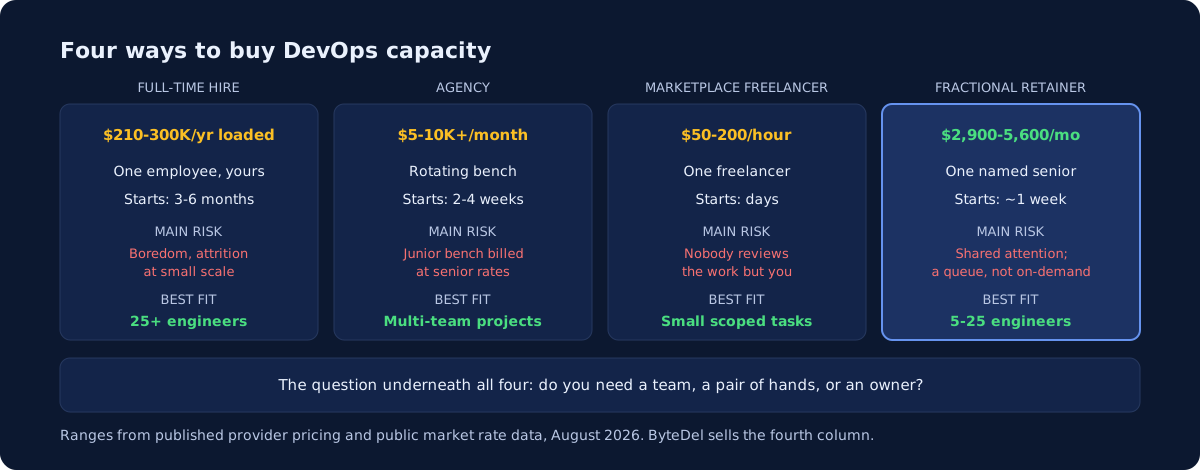
The short version. Fractional DevOps means one senior infrastructure engineer who owns your platform on an ongoing retainer, at a fraction of a full-time seat. The published Western market runs roughly $2,900–5,600/month — against a fully loaded US full-time hire at $210,000–300,000 in year one. It fits teams of roughly 5–25 engineers who need ongoing ownership but not 40 hours a week of it. It does not fit multi-team platform builds (hire an agency), single scoped tasks (hire a freelancer), contractual 24/7 on-call (staff it properly), or companies where infrastructure is the product (hire in-house, now). The things that decide whether it works are boring and contractual: where the code lives, what the turnaround promise is, what gets written down, and what the exit looks like.
Disclosure, up front: ByteDel sells fractional DevOps. We have an obvious commercial interest in you choosing this model. We’ve tried to write the guide we’d want to read if we were buying, including the four scenarios above where the honest answer is someone other than us — and we’ve labelled which claims are market data and which are how we choose to work.
What is fractional DevOps, exactly?
Fractional DevOps is an ongoing arrangement where a senior infrastructure engineer takes ownership of your platform for a defined slice of their capacity — typically a flat monthly retainer rather than an hourly meter. The distinguishing word is ownership, not hours: you’re not buying hands to execute tickets you wrote, you’re buying someone who decides what the tickets should be, does the work, and is accountable for whether the platform stays healthy.
The model exists because of a structural mismatch. A startup with 12 engineers has genuinely senior infrastructure needs — CI/CD that stays fast, a cloud bill that doesn’t quietly compound, a compliance posture that survives an enterprise security review — but usually 20–60 hours a month of that work, not 160. Fractional sells the seniority without the seat.
How does it differ from contracting, staff augmentation, agencies, and managed services?
These five things get sold interchangeably and are not interchangeable at all. The difference that matters is who is accountable for the outcome.
Contracting is scope-based. You define a project and a contractor delivers against a statement of work; accountability ends at delivery. Excellent when you know exactly what you want built, bad when your real problem is “we don’t know what we don’t know.”
Staff augmentation is capacity-based. You rent an engineer who takes your direction, and accountability stays with you — you set the agenda and judge the quality. This is what most offshore “dedicated engineer” offerings actually sell, whatever the marketing calls it, and it works when you have a technical lead who can review what comes back.
Agencies are team-based. You buy a bench sized to a project, and they can field three or five people at once, which no individual can. The structural weakness is equally consistent: you’re sold by a senior architect and delivered by whoever is available, and hourly billing quietly pays for slowness.
Managed services are SLA-based. An MSP runs defined infrastructure to a contractual service level, usually 24/7. You’re buying uptime coverage and a support desk, not judgment about your architecture — MSPs are measured on not breaking things, the right incentive for keeping lights on and the wrong one for changing how you deploy.
Fractional is ownership-based. One named senior engineer learns your stack once and stays with it — deciding, doing, documenting. It’s closest to what a good first DevOps hire would do, minus the salary, the recruiting cycle, and the attrition risk. We compare the three most commonly confused options in Agency vs. Freelancer vs. Fractional DevOps.
Who is fractional DevOps actually for — and who should skip it?
The fit profile is narrower than most providers admit. Fractional works when infrastructure needs continuous ownership but generates part-time volume, when nobody internally can evaluate infrastructure work, and when you can tolerate a queue rather than instant availability. Outside those conditions something else is cheaper or better — sometimes dramatically so.
The teams it genuinely fits
- 5–25 engineers, funded, shipping a product. Real infrastructure, no platform team, and a CTO who is currently the accidental DevOps person.
- Nobody in-house can review infrastructure work. The strongest signal of all. If you can’t tell good Terraform from bad Terraform, a freelancer is a gamble and an agency is unverifiable. You need an owner, not a resource.
- Compliance arriving before headcount does. An enterprise deal asks for SOC 2 and suddenly you need evidence, controls, and a posture that survives an audit — see our SOC 2 infrastructure checklist.
- Cost compounding faster than revenue. Cloud spend that grew organically almost always contains structural waste; Kubernetes cost optimization is typical of work that pays for a retainer outright but doesn’t justify a hire.
- The founding engineer’s context is a single point of failure. One person knows how deploys work and it’s undocumented — a bus-factor problem a retainer is well shaped to fix.
When the answer honestly isn’t fractional
Better said plainly here than discovered in month three.
Hire an agency when the work is genuinely a multi-person project — a migration across several squads, a platform build with parallel workstreams, anything needing three or more engineers at once. One engineer working a queue cannot compress calendar time the way a team can.
Hire a marketplace freelancer when the task is small, precisely scoped, and reviewable: “fix this Dockerfile,” “set up this one pipeline.” A monthly retainer for a two-day task is bad arithmetic.
Buy managed services, or staff on-call properly, when you have contractual 24/7 obligations. A solo fractional engineer promising round-the-clock coverage is either lying or planning to be unavailable at the worst moment — the most common dishonest promise in the category.
Hire full-time, now when infrastructure is your product, when you’re building an internal developer platform rather than maintaining systems, or when you’re past roughly 25 engineers. The full break-even reasoning is in Fractional DevOps vs. a Full-Time Hire, and the earliest-stage version of the question in when to hire your first DevOps engineer.
What engagement models exist, and how do they differ?
Four shapes dominate: flat retainer, request queue, dedicated days, and project-plus-support. They differ in what you’re actually buying — outcomes, throughput, time, or a deliverable — and in whose incentive the pricing structure serves. Read the incentive, not the brochure.
| Model | What you buy | Typical pricing shape | Best when | Watch out for |
|---|---|---|---|---|
| Flat retainer | Ongoing ownership, unmetered | One monthly number, cancel-anytime | Needs are continuous but modest; you want predictability | Scope creep in both directions — define what’s out of scope in writing |
| Request queue | Throughput, one or two active items | Monthly subscription, capped concurrency | Steady drip of well-defined work | Parallel urgency: two fires at once means one waits |
| Dedicated days | Time, explicitly | Per-day or per-block (e.g. 25h/month tiers) | You have an internal lead who sets the agenda | You’re back to managing the work; unused days often don’t roll over |
| Project + support | A deliverable, then upkeep | Fixed project fee, then smaller retainer | Clear one-time build (migration, launch, SOC 2 readiness) | The support tail being an afterthought priced as a rounding error |
The pattern worth internalising: flat pricing rewards finishing, hourly pricing rewards lingering. A provider on a flat monthly fee wants your infrastructure to be boring, because boring is cheap for them to maintain. A provider billing hours has, structurally, no such interest. That’s not a claim about anyone’s integrity — it’s a claim about which behaviours each contract makes profitable.
For the record, ours is a flat retainer with a request queue: $2,900/month, one active request at a time, cancel with no notice period beyond the current month, published openly rather than quoted per buyer. The fixed-scope alternatives — a cloud launch, SOC 2-ready infrastructure — are priced as project-plus-support.
What does good fractional DevOps look like operationally?
Good is defined by four written commitments: a turnaround expectation, a communication cadence, an honest coverage window, and a documentation standard. If a provider can’t put all four in writing before you sign, they haven’t thought about them — and you will be the one who discovers that.
Turnaround and communication cadence
The realistic promise for a shared senior engineer is business-day turnaround measured in days, not hours — the published market clusters around 48 hours to three days for non-urgent requests. Ours is 2–3 days typical, with a written progress update every Friday. What matters is less the specific number than whether it’s stated at all, and whether “urgent” is defined separately from “normal.”
Cadence matters more than most buyers realise, because infrastructure work is invisible when it’s done well. A month where nothing broke, the bill dropped slightly, and two pipelines got faster looks identical to a month where nobody did anything. A weekly written summary and a visible request board convert invisible work into something you can evaluate. “You can always ask me” is not a cadence.
On-call: the honest version
Here is what the category tends to fudge. One person cannot provide 24/7 on-call. They sleep, they travel, they get ill. Any solo provider selling round-the-clock coverage is selling something they cannot deliver on the night it matters.
What a fractional engineer can deliver is usually more valuable at this size anyway: alerting that pages the right human, runbooks so whoever is awake can execute the fix, blast-radius reduction so fewer things wake anyone, and fast senior response during agreed hours. Most sub-25-engineer startups need good alerting and a competent business-hours owner, not a staffed night shift. If you genuinely need the night shift, that’s an MSP or a rota of your own employees — budget accordingly.
Escalation and who owns the code
Escalation is a two-line answer in writing: what counts as an incident, and what happens if the engineer is unreachable. A serious provider names a backup path, even if that path is “here are the runbooks and the vendor support contract we set up for you.”
Ownership is the most important term in the whole arrangement, and it’s simple: everything lives in your repositories and your cloud accounts, from day one. Terraform or OpenTofu, pipeline definitions, runbooks, dashboards, alert rules — all yours, in version control, readable by an engineer who never met the person who wrote it. If a provider keeps infrastructure code in their own repos, builds on proprietary tooling you can’t take with you, or promises to “hand it over at the end,” you haven’t bought a capability — you’ve rented a dependency whose switching cost is the whole system. Fractional either builds durable value or quietly builds lock-in, and which one is decided in week one.
What does fractional DevOps cost, and how do the models compare?
Published Western fractional and subscription DevOps pricing in 2026 sits at roughly $2,900–5,600 per month. Below that band is the offshore dedicated-engineer market at $18–25/hour; above it, traditional agencies at $5,000–10,000+/month, almost never published. The band is narrow enough that price alone rarely decides — what differs is what the money buys.
| Model | Market range (2026) | Source of figures | What you’re paying for | Main cost risk |
|---|---|---|---|---|
| Full-time hire (US) | $210–300K/yr loaded | Base $134–170K per Indeed ($133,662 posting average) and Levels.fyi (~$170K avg total comp); +25–40% loading; +20–25% recruiting fee | A full seat, full context, full availability | Paying a full-time salary for part-time volume |
| Full-time hire (UK/EU) | £90–100K loaded on a £70K base | IT Jobs Watch UK median £70,000 (London £85K); Talent.com ~€65–80K for German hubs | Same, in a cheaper cash market | Employer NI, pension, and social charges narrow the gap |
| Fractional retainer | $2,900–5,600/mo flat | Published provider pricing, Aug 2026 (e.g. InstaDevOps $2,999–4,999/mo; devopX $3,000–5,590/mo) | One senior owner, part-time by design | Paying for a queue you don’t use |
| Agency | $5,000–10,000+/mo | Common quoted range; rarely published publicly | A team and a PM layer | Junior bench billed at senior rates |
| Marketplace freelancer | $50–200/hour | Upwork and Toptal rate bands | Hands, on your direction | Your management time, and unreviewed work |
| Offshore dedicated engineer | $18–25/hour (~$2,900–4,000/mo) | Advertised offshore agency rates | A bench seat you manage | Rotation and seniority variance |
Two notes on reading that table honestly. The fractional and offshore bands overlap on price but not on product — one is a senior owner making decisions, the other a managed seat you direct; comparing them on monthly cost alone is the most common buying mistake in this category. And price transparency is itself a signal: a provider who needs three discovery calls before naming a number is pricing you rather than the work. We surveyed who publishes what in Top Fractional DevOps Providers in 2026, and broke out the cost question in our guide to fractional DevOps cost and the salary math in DevOps engineer salary vs the fractional math.
How do you evaluate a fractional DevOps provider?
Ask questions whose answers can’t be improvised. Most buyers hire a DevOps provider exactly once, with no basis for comparison, which is why weak providers survive on adjectives. These are designed so a good provider enjoys answering and a weak one changes the subject.
The questions that expose depth
- “Who exactly does the work, and can I meet them before signing?” A named engineer, on the call. “We’ll assign the best available resource” is the bench, described politely.
- “Where does the infrastructure code live?” Your repos, your accounts, from day one. Anything else is lock-in with a friendly face.
- “What does it cost — on this call?” A number, or a public pricing page.
- “Walk me through the last thing you debugged that took more than a day.” The depth question. Real practitioners tell you about the wrong hypothesis they chased first; shallow ones give a tidy narrative with no dead ends.
- “What would you not do for us?” Everyone with real experience has a list — technologies they won’t recommend at your stage, work they’d tell you to hire for instead.
- “How do you handle what you don’t know?” Nobody is expert in AWS, GCP, Azure, Kubernetes, and every compliance framework at once. The good answer describes getting to competence fast and being honest about the gap meanwhile.
- “When should we stop paying you?” The most revealing one, because a weak provider’s plan is forever.
The full version, with the answers a good provider gives, is in 7 questions to ask a DevOps provider.
The answers that should worry you
- “We provide 24/7 support” from a solo operator or two-person shop. As above: it isn’t real.
- “It depends” with no ranges, after you’ve described your stack and team size.
- Open-ended hourly billing with no cap and no fixed-scope option.
- Logos and adjectives with nothing inspectable — no sample deliverable, no redacted report, no dashboard.
- No exit condition. A provider who can’t describe when you should leave them is describing a subscription, not a service.
- Vague deliverable language — “production-grade,” “best practices,” “enterprise-ready” — that never resolves into a named artifact.
What should the first 30, 60, and 90 days produce?
Concrete artifacts, in a predictable order: understand, stabilise, improve. The first 90 days are the period in which you find out whether you hired an owner or a ticket-taker, and the tell is whether things get written down or merely fixed.
Days 1–30 — understand and stop the bleeding. A written assessment across compute, networking, CI/CD, secrets, backups, monitoring, and access; an inventory of what exists and what it costs; access properly scoped; the two or three highest-severity risks fixed or logged with a plan. By day 30 you should hold a document that tells you things about your own infrastructure you didn’t know.
Days 31–60 — codify. The highest-value work here is turning tribal knowledge into repository content: infrastructure as code for anything currently clicked into a console, a documented deploy path, runbooks for the three most likely failures, alerting that fires on symptoms users feel rather than CPU graphs. Cost work usually lands here too, because by now the engineer knows which resources are load-bearing.
Days 61–90 — improve and prove. Measurable movement on something you care about: deploy frequency, build time, monthly spend, incident count, audit readiness. Plus a handover test — can a new engineer follow the documentation and deploy without asking anyone? If that answer is no at day 90, the engagement is building dependency rather than capability, and it’s worth raising immediately rather than at renewal.
The services page lists what our own scoped engagements produce, if you want a concrete example.
What are the risks, and how do you mitigate them?
Four real ones: bus factor, context loss, security exposure, and a bad exit. All four are manageable, and all four are managed by contract terms and working practices rather than by trust.
Bus factor. You’ve concentrated infrastructure knowledge in one part-time person outside your company. Mitigation: everything as code in your repos, runbooks for common failures, and at least one internal engineer who reviews infrastructure PRs even if they don’t write them. That last one is the cheapest insurance available and almost nobody does it.
Context loss. A part-time engineer isn’t in your planning meetings and won’t hear the architectural decision made in a hallway. Mitigation: a standing written channel, inclusion in relevant design reviews rather than all meetings, and a short monthly conversation about what’s coming — not only what broke.
Security and access. You’re granting an external party production credentials. Mitigation: named individual accounts (never shared), least-privilege scoped roles, SSO where possible, break-glass credentials rotated on departure, audit logging on, and access reviews at a fixed cadence. A provider who resists this — or asks for a root-equivalent key for convenience — is telling you how they treat every other client’s environment too.
Exit and handover. The failure mode isn’t dramatic; it’s discovering at cancellation that the knowledge was never really yours. Mitigation is entirely front-loaded: your repos and accounts from week one, documentation as a deliverable rather than a favour, no provider-proprietary platforms, and a handover document that exists continuously rather than being written at the end. A good exit is a git pull and a conversation. A bad one is an archaeology project.
How do you measure whether it’s working?
Four signals, and only one of them is a dashboard. Measure delivery throughput, cost trend, incident load, and — the one everyone skips — what your engineers say about friction. Any single metric can be gamed; the four together are hard to fake.
Delivery metrics (DORA). The DORA program at dora.dev now defines five software delivery metrics rather than the original four: change lead time (commit to production), deployment frequency, change fail rate (deployments needing immediate intervention), failed deployment recovery time, and the newer deployment rework rate (unplanned deployments caused by a production incident). You don’t need elite numbers; you need the trend to move the right way over a quarter and to know why when it doesn’t.
Cost trend, normalised. Absolute cloud spend is a bad metric because growing companies should spend more. Track cost per unit of business — per customer, per request, per environment — and expect that to improve even while the total rises. A retainer that doesn’t pay for a meaningful share of itself in cost work within a couple of quarters is worth a conversation.
Incident load. Count both incidents and pages. A common early win is a large reduction in noisy alerts with no increase in missed problems — fewer pages, unchanged or better recovery times. Alert fatigue is the quietest infrastructure tax there is.
Developer-reported friction. Ask your engineers the same few questions each quarter: how long does a deploy take, how confident are you shipping on Friday, how often does infrastructure block you, how easy is it to spin up an environment? These catch what dashboards miss and lead the other three. If the metrics improve and your developers don’t feel it, something is being measured that doesn’t matter.
When should you graduate to a full-time team?
At roughly 25 engineers, or earlier if the signals below show up first. The transition is visible months ahead, and a good provider will raise it before you do — ours is written on our pricing page as an explicit exit condition.
The signals that it’s time:
- The request queue is consistently full and turnaround time hurts weekly rather than occasionally.
- You need someone in sprint planning and architecture reviews by default, not on request.
- You have real 24/7 obligations that a retainer cannot contractually cover.
- You’re building an internal developer platform for other teams rather than maintaining systems — a genuinely different discipline, which we unpack in Platform engineering vs. DevOps.
- Infrastructure has become a product differentiator rather than a cost of doing business.
The graceful path isn’t a cliff. Use the retainer to bridge the search — three to six months in which the fractional engineer keeps things healthy, writes the job description with you, sits in on technical interviews, then hands over to your new hire during the overlap. That handover is dramatically cheaper if everything has been in your repos all along, which is the argument for insisting on it on day one, even when leaving feels a long way off.
Where to start
The useful sequence is: work out what your infrastructure actually needs, work out how many senior hours a month that is, and only then choose a model. Under roughly 60 hours a month with nobody in-house to review the work, fractional is usually the right shape. Over 120 sustained hours, start recruiting.
Our free two-minute health check gives you the first part, the retainer page explains how we run one specifically, and a 15-minute call is the fastest route if you’d rather just ask. If the math says hire in-house, we’ll say so on that call — a worse outcome for us and a better one for you, and the only version of this business worth running.
ByteDel provides fractional DevOps for funded startups across AWS, GCP, and Azure — $2,900/month flat, published publicly, everything in your repos. Salary, rate, and provider pricing figures above are cited from public sources (Indeed, Levels.fyi, IT Jobs Watch, Talent.com, dora.dev, and providers’ own published pricing as of August 2026); they are market data, not our own measurements. Corrections welcome at [email protected].
Newsletter
One practical DevOps guide a week
Real numbers, honest trade-offs, no vendor fog — same as everything here. Unsubscribe anytime.