Guides · Kubernetes & Delivery · Strategy · Platform Engineering
Platform Engineering vs DevOps: What Startups Actually Need
· 3 min read
“Is DevOps dead?” is one of the most-searched infrastructure questions of 2026. The honest answer: the philosophy is fine; the DIY execution model is dying. Analyst firms project that 80% of software organizations will run dedicated platform engineering teams delivering internal developer platforms — self-service portals like Backstage or Port, golden-path templates, policy-as-code guardrails. The DevOps market itself is still growing at roughly 20% a year, but the job is being reshaped around platforms, not tickets.
Here’s what that means if you have 5–25 engineers — which is a very different answer than the enterprise one.
What is platform engineering, in one paragraph?
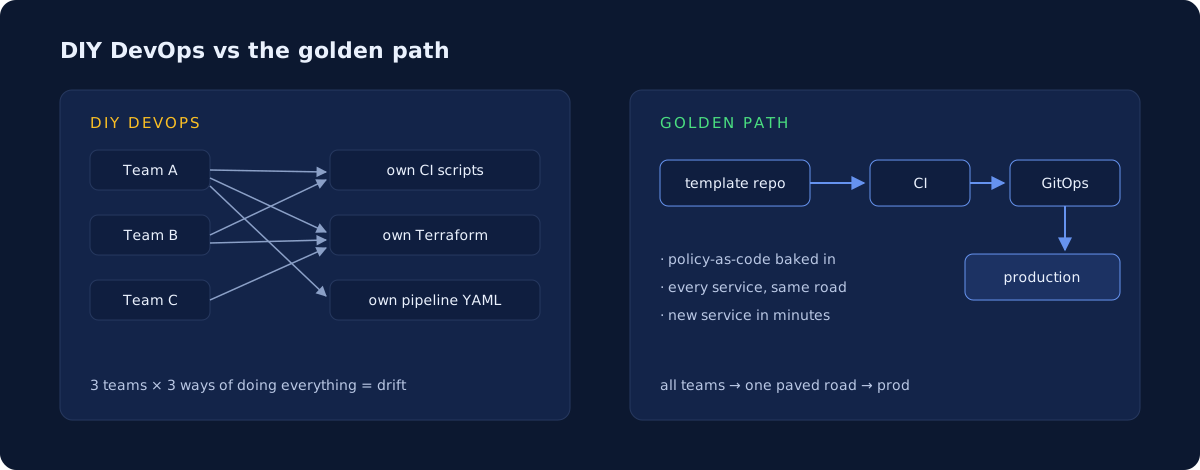
Platform engineering treats internal infrastructure as a product. Instead of every product team writing its own Terraform, Dockerfiles, and pipeline YAML (the “DIY DevOps” model), a platform team builds golden paths: pre-approved, self-service templates that provision compliant environments, pipelines, and monitoring in minutes. Success is measured in DORA metrics — deployment frequency, lead time for changes, change failure rate — not ticket resolution speed.
Why enterprises are switching
The DIY model collapsed under cognitive load. Studies behind the trend report product developers spending up to 40% of their time wrestling with tooling instead of shipping features, inconsistent security postures across teams, and every squad reinventing the same pipeline slightly differently. With senior US DevOps/SRE salaries at $220K–300K fully loaded, enterprises can’t fix that by hiring more operators — so they build platforms that let developers self-serve.
Should a startup build an internal developer platform?
No — not a portal, anyway. Backstage and its peers pay off when you have dozens of teams and someone to maintain the platform as a product. At 5–25 engineers, an IDP is a part-time job nobody has, solving coordination problems you don’t have yet.
What you should steal is the principle: paved roads instead of tribal knowledge. In practice, at startup scale, that means:
- One golden path to production. A single template repo: service scaffold, Dockerfile, CI workflow, Terraform module, alerts. New service = copy, rename, deploy. No decisions to make.
- GitOps as your “platform.” Argo CD reconciling a Git repo gives you self-service deploys, audit trails, and rollback — 80% of what a portal provides, at 2% of the cost.
- Policy baked in, not reviewed in. A handful of Kyverno policies (no
:latesttags, resource limits required, no privileged pods) enforce standards automatically instead of via review comments. - DORA metrics on a dashboard. Deployment frequency and change failure rate tell you whether any of this is working. Uptime checks alone don’t.
Do you still need a DevOps engineer, then?
You need the outcomes — someone has to build the golden path, wire the GitOps loop, and own reliability. What’s changed is the math on how to buy those outcomes. A full-time platform hire at startup scale is a $200K+ solution to a part-time problem. The pattern the market has settled on: a senior engineer builds the paved road as a project, then maintains it fractionally while your product engineers use it daily.
That’s precisely the model behind our Cloud Launch package (the golden path, built in 2–3 weeks, in your repos) and our monthly retainer (the platform team, at $2,900/month instead of $250K/year).
The bottom line
Platform engineering isn’t a tool you install; it’s the discipline of making the right way the easy way. Enterprises need portals and platform teams to do it. You need one paved road, GitOps, and a few guardrails — and you can have that in weeks, not quarters. Not sure where you stand? The 12-question health check scores exactly these gaps, no email required.
Newsletter
One practical DevOps guide a week
Real numbers, honest trade-offs, no vendor fog — same as everything here. Unsubscribe anytime.