Guides · Hiring & Strategy · Hiring
When Should a Startup Hire Its First DevOps Engineer?
· 7 min read
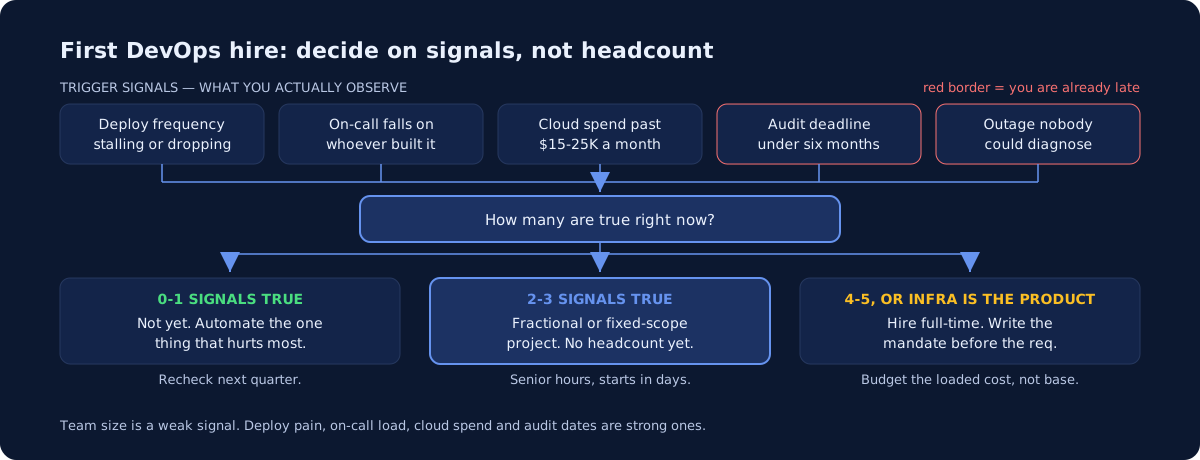
Hire your first DevOps engineer when infrastructure work has become someone’s unofficial full-time job — not when you cross an engineer count. In practice that lands somewhere between 15 and 25 engineers for most funded startups, but headcount is the weakest signal available. The strong ones are observable this week: deploys slowing down, on-call landing on whoever happened to build the thing, a cloud bill nobody can explain, an audit date on the calendar, or an outage that took hours because no one knew where to look. Count how many are true. One is normal. Four means you should have started three months ago. If the honest answer is “not yet, but soon”, fractional DevOps is the usual bridge.
What are the actual trigger signals?
Five, all measurable without a consultant. Each has a different right answer — a compliance deadline and a slow CI pipeline are not the same problem, and neither on its own justifies a headcount. Map the signal to the response before you write a job description.
| Trigger signal | What it actually means | Right response |
|---|---|---|
| Deploy frequency dropping (weekly → monthly), or releases need a “deploy person” | CI/CD has decayed faster than the team can maintain it | Fixed-scope pipeline project, 2–6 weeks. Not a hire. |
| On-call is “whoever built it” — no rota, no runbooks, no escalation | Reliability is an accident, and your best engineers absorb it silently | Fractional or part-time ownership until load justifies a rota |
| Cloud spend past $15–25K/month with no owner | Waste is now larger than the cost of managing it | Recurring cost review, tagging, budget alerts |
| SOC 2, ISO 27001 or HIPAA deadline under six months | Evidence work is on a hard external clock | Specialist help now; a generalist hire won’t ramp in time |
| An outage nobody could diagnose | No observability, no ownership — the expensive signal | Fix observability first, then decide on the hire |
| Three or more, sustained for a quarter | Infrastructure is a full-time job at your company | Hire full-time, with a written mandate |
The cost threshold is worth arithmetic rather than intuition. Flexera’s 2026 State of the Cloud Report puts wasted spend on IaaS and PaaS at 29%, with 17% of organisations exceeding their public cloud budgets. At $20K a month across AWS, GCP or Azure, that’s roughly $70,000 a year of waste — real money, but still a third of what a hire costs. At $60K a month it comfortably pays for the person.
What does the role actually do at 10 engineers versus 25?
They are two different jobs with the same title, which is the single biggest cause of a failed first hire. At 10 engineers the work is broad and shallow: keep CI green, own Terraform, patch the cluster, keep the bill sane. At 25 it becomes narrow and deep — internal platform, golden paths, self-service environments, an on-call rota other people are actually on.
At 10 engineers it is rarely 40 hours a week of genuinely senior work. At 25, enablement dominates and starts to look like platform engineering — building things other engineers use, rather than doing things for them. A senior hired for the second job who arrives to find the first one gets bored; a mid-level engineer hired for the first and handed the second drowns.
Why does the first DevOps hire so often fail?
Two failure modes, both structural rather than personal. The first is hiring a firefighter with no mandate: the person joins to “fix infrastructure,” has no authority to change how anyone deploys, and spends a year unblocking tickets while the underlying design stays untouched. The second is hiring too junior for an unowned stack — a mid-level engineer inheriting a decade of accumulated decisions from people who left, with nobody to check their work.
There is a third, quieter one: retention. A strong senior who fixes your infrastructure in nine months has, by month twelve, nothing interesting left to do at a 12-person company. They leave with the undocumented knowledge, and you pay the recruiting fee again. Salary data makes that repeat expensive — Indeed’s US DevOps engineer average sits at $133,662 base (4,300 job postings, updated August 2026), while Levels.fyi puts average total compensation nearer $170,000. Loaded with taxes, benefits, equity and a contingency fee, year one lands well above either figure; the full breakdown is in DevOps Engineer Salary vs the Fractional Math.
You can defuse all three before you post the req. Write the mandate first — three outcomes with dates, not a tools list. Decide what they’re allowed to change unilaterally. And be honest about whether year two has enough work to keep them.
What are the honest alternatives?
Four, each genuinely better than a hire in specific circumstances:
- Fractional DevOps. Senior ownership for a fixed monthly fee, starting in days. Best at 20–60 hours of real infrastructure work a month with no appetite for a $200K+ commitment. Weakness: a request queue, not instant availability, and no 24/7 on-call.
- An agency or project shop. Good for bounded work — a migration, a Kubernetes build-out, an audit push. Weakness: incentives favour scope, and continuity ends when the invoice does.
- Managed platforms (PaaS). App Runner, Cloud Run, Container Apps, Render, Fly.io. Genuinely right for many pre-Series-A teams: pay a margin on compute to not need the role at all. Weakness: a cost curve and a control ceiling once you need VPC peering, complex data services, or bespoke compliance controls.
- Upskilling an existing engineer. Cheapest on paper, and it works when someone actively wants the role. It fails when it’s assigned rather than chosen. If you do this, buy them senior review, not just a training budget.
The hire-versus-retainer break-even math is in Fractional DevOps vs a Full-Time Hire.
How do you know you’ve waited too long?
Four tells, in rough order of severity. Product engineers are spending more than a day a week on infrastructure. Your deploy process has an undocumented step only one person can do. An incident took hours to diagnose because nobody owned observability. Or a customer contract is blocked on a security questionnaire you can’t answer.
The last is the expensive one, because it converts an engineering problem into a revenue problem with an external deadline — and hiring under that pressure is how mis-hires happen. If two or three of these are true, bridge the gap with fractional cover while you run a proper search, rather than making a rushed offer to whoever is available in six weeks.
When is a full-time hire clearly the right call?
Four cases, and in all of them an honest fractional provider should tell you to hire. First: infrastructure is your product — you sell a platform, a data pipeline, or anything where reliability engineering is a differentiator rather than an overhead. Second: you need genuine 24/7 on-call with contractual response times, which a shared retainer structurally cannot provide. Third: you’re past roughly 25 engineers and the request queue is permanently full, so turnaround hurts weekly. Fourth: you’re deliberately building a platform team and this is hire one of three — a strategy, not a stopgap.
If you’re unsure which side of the line you’re on, the cheapest way to find out is an external read of your actual infrastructure — our health check does that, and the cost calculator prices each option at your size.
ByteDel provides fractional DevOps for funded startups across AWS, GCP and Azure. Salary and cloud-spend figures above are cited market data, not our own measurements.
Newsletter
One practical DevOps guide a week
Real numbers, honest trade-offs, no vendor fog — same as everything here. Unsubscribe anytime.