Guides · Kubernetes & Delivery · Deployment · Developer Experience
Preview Environments: The End of the Shared Staging Server
· 3 min read
“Kill your staging environment” went from hot take to mainstream engineering-blog consensus, and the search interest follows: teams are replacing the single shared staging server with ephemeral preview environments — a disposable copy of the app spun up per pull request, destroyed on merge. Here’s the version of that story that makes sense at startup scale.
Why does shared staging break down?
Because it’s a queue pretending to be an environment. One staging means one team’s half-tested branch blocks everyone’s release; “is staging broken or is it my change?” becomes a daily standup topic; the environment drifts from production (smaller instances, stale data, missing services) until green-on-staging stops predicting green-on-production. You pay for it 24/7 and trust it less every month.
What replaces it?
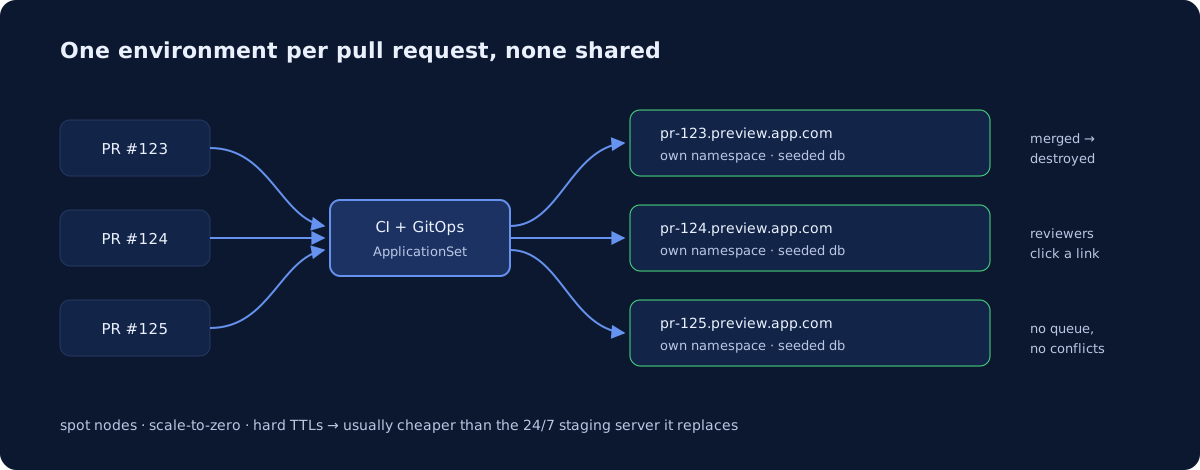
Per-PR preview environments. CI builds the branch, deploys it to an isolated namespace with its own URL (pr-123.preview.yourapp.com), posts the link on the pull request, and tears everything down on merge. Reviewers click instead of pulling branches; QA tests features in parallel instead of queueing; every environment is built by the same automation as production, so drift can’t accumulate. With GitOps this is remarkably little machinery — Argo CD ApplicationSets can generate an application per open PR — and GitHub Actions handles build-and-comment.
What about the database?
The real design decision. The working options, in order of increasing effort: a seeded per-preview database from fixtures (right default for most startups — migrations run against it, tests are deterministic); a nightly-refreshed anonymized snapshot when realistic data shapes matter; and for large datasets, copy-on-write branching (Neon, PlanetScale, or snapshot-based clones) that makes a full-size copy cheap. What you don’t do is point previews at a shared database — that quietly rebuilds the coupling you were escaping.
And the enterprise version — testing against production?
The trend’s far end (request-level isolation: sandboxed service instances receiving tagged traffic inside production, via service-mesh routing) solves a problem you probably don’t have — dozens of microservices too numerous to duplicate per PR. It requires a mesh, header-propagation discipline, and real platform investment. At 5–25 engineers with a handful of services, full-copy previews are simpler, safer, and achieve the same outcome. File the mesh version under “later, maybe.”
What does it cost to run?
Less than staging, usually. Previews are small (one replica of everything, spot nodes, scale-to-zero on inactivity, hard TTLs so abandoned PRs die) and exist only while PRs are open — a cluster running eight previews on spot capacity typically costs less than the always-on staging server it replaced. The cluster cost tactics apply doubly here.
A pragmatic migration path
Don’t delete staging on day one. Add previews for the main app first — that alone removes the queue, which is 80% of the pain. Keep a thin, boring staging as the pre-production soak for infrastructure changes if you want it; many teams find that once previews exist, staging quietly stops being fought over and can shrink or die on its own schedule.
Setting this up — pipeline, ApplicationSet, database seeding, TTL cleanup — is a typical fortnight’s project inside a DevOps retainer, or part of the delivery pipeline in a Cloud Launch build. If your team is arguing about who gets staging this week, that’s the queue talking, not the people.
Newsletter
One practical DevOps guide a week
Real numbers, honest trade-offs, no vendor fog — same as everything here. Unsubscribe anytime.