Guides · AI & DevOps · ai-code-review · coderabbit · pull-requests
AI Code Review Tools in 2026: Do They Catch Real Bugs?
· 5 min read
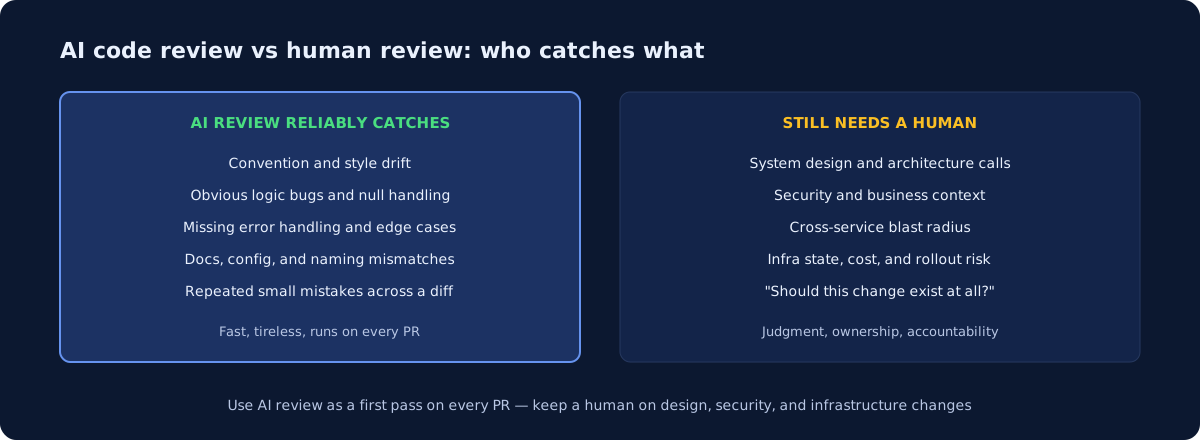
Yes — AI code review tools catch real bugs, but a specific class of them: convention drift, obvious logic errors, missing error handling, and inconsistencies a tired human skims past. What they don’t reliably catch is what senior reviewers exist for: design mistakes, security issues that depend on business context, and infrastructure changes whose risk lives outside the diff. In 2026 the honest framing is that AI review is an excellent first-pass filter and a poor last line of defense. Run one on every PR; don’t let it be the only reviewer on anything that touches production.
What do AI code review tools actually catch?
The reliable wins are pattern-shaped problems: code that deviates from the rest of the repo, unhandled nulls and error paths, off-by-one and inverted-condition bugs, dead code, and mismatches between the change and its docs, tests, or config. Because the tool reads every line of every PR with equal attention, it beats humans on consistency, not on depth.
In practice, the categories we see AI reviewers earn their keep on:
- Convention and style drift — naming, structure, and idiom inconsistencies across a codebase, especially with custom rules configured.
- Obvious correctness bugs — wrong variable used, missing await, swallowed exceptions, edge cases in string/date/pagination handling.
- Diff-local security smells — hardcoded credentials, injection-prone string building, overly permissive IAM snippets sitting right in the diff.
- Repetition — the same small mistake made twelve times in a large generated change, where a human reviewer checks three and extrapolates.
That last one matters more every quarter, because diffs are getting bigger. If your team ships large AI-assisted changes, pairing review tooling with good repo context files is the difference between signal and noise — see our take on AI assistants in large codebases.
What do they still miss?
AI review is weakest exactly where review matters most: questions whose answer isn’t in the diff. Is this the right abstraction? Does this endpoint leak data given how our tenancy model works? Will this Terraform change trigger a replacement of a stateful resource? Those failures require knowing the system, the business, and the state of the world — not just the text of the change.
Three blind spots we’d flag for any team:
- Design and architecture. Tools comment on how code is written, rarely on whether it should exist, or whether it duplicates a capability two services over.
- Contextual security. Diff-visible smells get caught; authorization logic that’s wrong for your product usually doesn’t. An AI reviewer doesn’t know that
org_idandbilling_account_idaren’t interchangeable in your domain. - Infrastructure blast radius. A Terraform or Helm diff can look immaculate and still destroy a database, because risk lives in state files, live traffic, and rollout ordering. This is why we treat infra PRs as their own review discipline — more on that in can AI agents safely run Terraform?
False-positive noise is the other real cost. Every tool in this space ships tuning knobs (path filters, custom instructions, severity thresholds) because an unconfigured bot that leaves fifteen nitpicks per PR trains engineers to ignore it. Budget a few hours to tune whichever tool you pick; it’s the highest-ROI configuration work in this category.
CodeRabbit vs Greptile vs Copilot: how do they compare?
All three are credible in 2026; they differ on depth of codebase context, pricing model, and how integrated they are with your existing GitHub spend. Pricing below is from each vendor’s published pages as of August 2026 — verify before buying, this market moves fast.
| Tool | Published pricing | Standout trait | Watch out for |
|---|---|---|---|
| CodeRabbit | $24/user/mo Pro (annual), $48 Pro Plus; free for public repos | Agentic reviews with 1-click fixes, learns team preferences, CLI/IDE review included | Feature sprawl; tune it or drown in comments |
| Greptile | $30/seat/mo Pro, credit-based (50 credits/seat); free tier, ~50% off for pre-Series A startups | Full-codebase context graph — strongest at cross-file reasoning | Credit math on busy monorepos |
| Copilot code review | Included from $10/mo Pro; draws on plan AI-credit allowances, per GitHub’s docs | Zero new vendor, always leaves a non-blocking “Comment” review in under ~30s | Shallower “Lite” default; use the Balanced effort level for real analysis |
For a 5–25 engineer startup, our default recommendation: if you already pay for Copilot, turn its code review on today — it’s nearly free marginal spend. If review quality becomes a bottleneck, trial CodeRabbit or Greptile on your two busiest repos for a month and count actioned comments, not total comments.
Should AI review AI-written code?
Yes — and it’s arguably where AI review works best, because AI-generated code fails in exactly the pattern-shaped ways AI review catches: subtle API misuse, plausible-but-wrong logic, and volume no human wants to line-read. The mistake is thinking two AIs close the loop. An assistant that wrote the bug and a reviewer sharing similar training can share similar blind spots, so the human shifts role: from line-by-line reader to verifier of intent, tests, and blast radius.
The workflow we recommend clients adopt: AI writes, AI reviews as the first gate, CI proves behavior, and a human approves with explicit attention on design, security, and anything touching infrastructure. That’s also our position in do startups still need DevOps if AI writes the code? — the leverage moves to the people who own verification.
Who reviews your infrastructure PRs?
This is the gap we see most at 5–25 engineer startups: AI review bots and app developers both hesitate on Terraform, Kubernetes, and IAM changes, so infra PRs either self-merge or rot. A senior human reviewing those specific PRs is disproportionately valuable, because that’s where AI review is weakest and blast radius is largest — across AWS, GCP, and Azure alike.
You don’t need a full-time hire for it. Reviewing infra PRs, tuning your AI review config, and owning the deploy path is exactly the shape of our retainer service — a few days a month of senior review where the bots tap out. If you’d rather start with a one-time look at your setup, see pricing for an audit.
Bottom line: AI code review in 2026 is worth running on every PR — it catches real bugs cheaply and tirelessly. Just be honest about the split: bots for patterns, humans for judgment, and a named owner for every change that can take down production.
Newsletter
One practical DevOps guide a week
Real numbers, honest trade-offs, no vendor fog — same as everything here. Unsubscribe anytime.