Guides · Compliance & Certifications · soc2 · timeline
How Long Does SOC 2 Actually Take? A Realistic Timeline
· 7 min read
For a 10–25 person startup starting cold, SOC 2 Type I realistically lands in two to four months and Type II in roughly six to fifteen months, the spread depending almost entirely on the observation window you choose. Secureframe’s published guide puts the Type I path at 2–4 months end to end; Vanta’s published audit timeline is tighter at five weeks to two months for Type I, and puts the full Type II path at 5.5 months to 18+ months. Both ranges are wide for one reason: the calendar is dominated by two variables you control — remediation speed and declared window length — and one you don’t, your auditor’s schedule.
How long does SOC 2 Type I take?
Two to four months from a cold start, and about 4–6 weeks for the audit itself once you are genuinely ready. Secureframe splits Type I into 1–3 months of pre-audit preparation plus roughly a month of audit; the audit firm Johanson LLP quotes 4–6 weeks to complete a Type I attestation. Vanta decomposes the same work further: 2–5 weeks of official audit, then 2–6 weeks for report creation and delivery.
That last number is the one founders miss. Fieldwork ending is not the report arriving — per Vanta, expect another two to six weeks before a PDF exists you can send a prospect. Count backwards from the report, not the audit.
How long does SOC 2 Type II take?
Five and a half months is the practical floor; twelve to eighteen months is normal with a long window. Per Vanta, the full Type II path runs 5.5 months to 18+ months: 1–3 months of pre-audit preparation, a 3-month-to-a-year observation period, then 2–5 weeks of audit and 2–6 weeks of report delivery. Secureframe’s estimate for a fully manual approach is longer still — 1 to 2+ years — which is an argument for automating evidence collection, not a different reading of the audit.
Note what dominates that arithmetic. Everything except the observation window totals a couple of months. The window is the timeline.
What does a realistic phase-by-phase timeline look like?
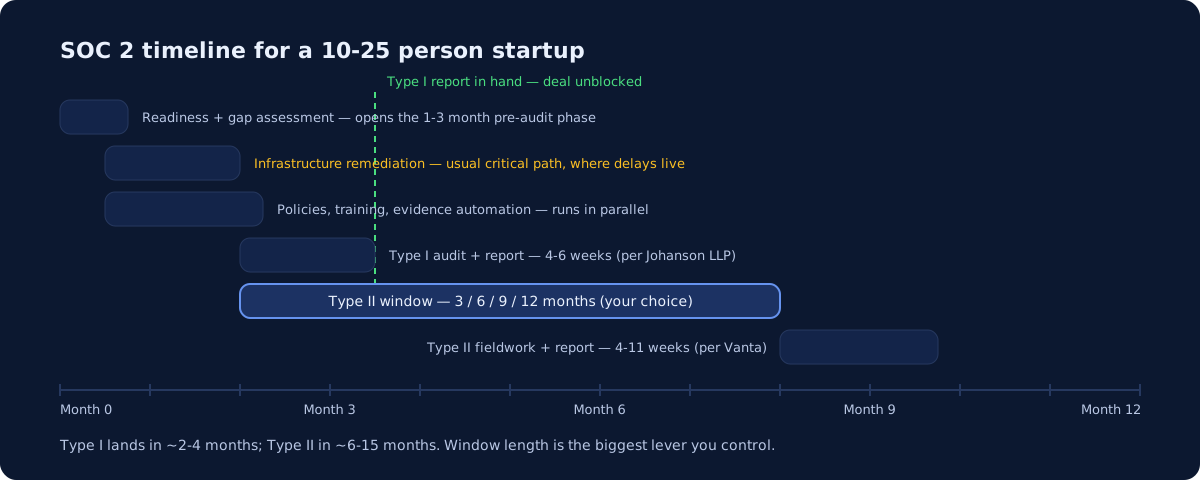
The sequence, with published durations attached. Rows without a vendor attribution are our own engagement shape, not industry figures.
| Phase | Typical duration | Source |
|---|---|---|
| Scope + readiness and gap assessment | Opens the 1–3 month pre-audit phase | Vanta |
| Infrastructure remediation (AWS, GCP, or Azure) | 3–4 weeks fixed-price | ByteDel package |
| Policies, training, evidence automation | Runs in parallel with remediation | — |
| Type I audit | 2–5 weeks | Vanta |
| Type I report creation and delivery | 2–6 weeks | Vanta |
| Type II observation window | 3, 6, 9, or 12 months — you choose | Vanta, Secureframe |
| Type II fieldwork | 2–5 weeks | Vanta |
| Type II report creation and delivery | 2–6 weeks | Vanta |
The parallel row matters more than it looks. Policy authoring, training, and vendor reviews do not depend on infrastructure work finishing, so sequencing them serially adds a month for no reason. Wire your compliance platform on day one so evidence accrues while remediation runs — the Vanta and Drata evidence automation setup is what makes that parallelism real.
Why is the observation window a choice rather than a fixed length?
Because it is literally a selection you make. Per Vanta, your options are three, six, nine, or twelve months, with three the minimum, and the trade-off is blunt: the longer the window, the stronger your posture looks. Johanson LLP describes the same pattern auditor-side — a minimum of 3 months for a first Type II period, 6 months where a customer demands it, 12 months for subsequent audits.
A three-month window is not cheating; it is the standard on-ramp. Take the shortest legitimate window for report one, then settle onto an annual cycle — which is not optional in practice either, since per Secureframe SOC 2 reports have no formal expiration date but most customers only accept one issued within the last 12 months.
What is the fastest legitimate path when a deal is blocked?
Remediate infrastructure, take Type I, and open the Type II window the same week — the two do not conflict. Johanson LLP puts it directly: doing a Type I will not slow you down in obtaining a Type II, because while the Type I audit is being performed you can already start the Type II audit period. That overlap is what turns “SOC 2 takes a year” into “you have a report in about a quarter.”
The compressed sequence: weeks 1–4 close the infrastructure gaps (our fixed-price SOC 2-Ready Infrastructure package is scoped for exactly this window), policy and training work runs alongside, Type I fieldwork follows, and the Type II clock starts the day the Type I audit date passes. Johanson also notes most CPA firms quote a bundled Type I plus Type II well below the separate prices — ask at the scheduling call, not after. For what each of those line items actually costs, see our SOC 2 audit cost breakdown. Fuller framework in our Type I vs Type II breakdown.
What actually causes SOC 2 delays?
Two things, in this order: infrastructure remediation that turns out bigger than the gap assessment suggested, and auditor scheduling. Vanta’s list of what keeps a timeline on track reads as a delay list in reverse — respond to audit firm follow-ups on time, complete evidence submissions within agreed timelines, integrate all in-scope systems, and have most automated tests passing by review. Every item is a dependency on someone being available.
The engineering blockers are predictable across AWS, GCP, and Azure: shared root or owner accounts with no SSO, IAM granting far more than anyone uses, no centralized log aggregation with a retention policy, unencrypted volumes or buckets, change management that exists only as a Slack norm, and backups nobody has restored. None are hard individually; together they are several weeks teams routinely budget zero for. Full list in our SOC 2 infrastructure checklist.
On the auditor side the fix is calendar discipline: firms book out, and a slot you did not reserve during readiness becomes a four-week gap between “ready” and “fieldwork starts.” Book the audit before you finish remediating.
Can a Type I unblock a deal while Type II is still running?
Yes, and it is the standard play for deal-driven startups. Vanta’s guidance is explicit that you can start with a Type I to get your first report back quickly and later progress to a Type II as the business grows. For most mid-market procurement teams, a Type I in hand plus a named end date for your Type II window is enough to move a security review from blocking to conditional.
Large enterprise security teams are the exception and increasingly want Type II specifically — which is exactly why you open the window immediately instead of waiting to see whether Type I suffices. Where each framework fits by funding stage is in our startup compliance roadmap.
What should you do this week?
If a deal is blocked, the highest-leverage move is a gap assessment against your actual cloud accounts rather than a policy template — remediation, not paperwork, sits on the critical path. That is the engagement we run at a fixed price in a fixed 3–4 week window; see pricing for scope and terms.
This is engineering guidance, not legal or audit advice — confirm scope, window length, and report timing with your auditor before committing to a customer date.
Newsletter
One practical DevOps guide a week
Real numbers, honest trade-offs, no vendor fog — same as everything here. Unsubscribe anytime.