Guides · Compliance & Certifications · SOC 2 · Budget
How Much Does a SOC 2 Audit Cost for a Startup?
· 6 min read
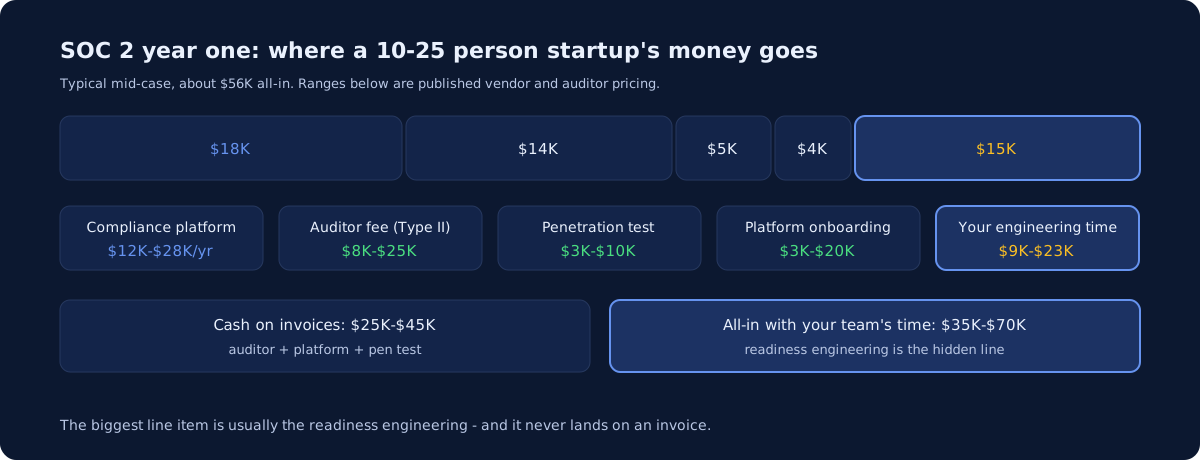
For a funded startup with 10-25 people, the realistic all-in cost of a first SOC 2 in year one is $35,000-$70,000 — of which only about $25,000-$45,000 ever arrives as an invoice. The rest is your own engineers rebuilding infrastructure until the controls are actually true. The auditor’s fee is almost never the biggest number on the page, and the line that blows the budget is the one nobody quotes you: readiness and remediation engineering.
What does the full year-one bill look like?
Five line items account for nearly all of it: the compliance platform subscription, the auditor’s fee, a penetration test, optional platform onboarding services, and your own engineering time. Four come with a quote. The fifth is the largest for most teams and shows up only as slipped roadmap.
| Line item | Typical year-one range | Source |
|---|---|---|
| Compliance platform (1-50 employees) | $12,000-$28,000/yr | Vendr’s Vanta and Drata buyer guides |
| Platform onboarding / implementation services | $3,000-$20,000 one-time | Vendr (Drata $5K-$20K; Secureframe $3K-$10K+) |
| Auditor fee, SOC 2 Type II | $8,000-$25,000 | Vendr’s Drata buyer guide |
| Auditor fee, traditional firm (Type I / Type II) | $20,000-$50,000 / $30,000-$100,000+ | Compass IT Compliance |
| Readiness assessment bought as a service | $15,000-$25,000 | Compass IT Compliance |
| Penetration test | $3,000-$10,000+ per test | Vendr’s Vanta buyer guide |
| Trust center / questionnaire automation | $3,000-$8,000/yr | Vendr’s Vanta buyer guide |
| Vendor risk management module | $5,000-$15,000/yr | Vendr’s Vanta buyer guide |
| Internal readiness engineering | ~$9,000-$23,000 (derived, see below) | Built In salary data |
Nobody pays every row. A lean startup path — platform, boutique auditor, one pen test, readiness done in-house — lands near $25,000 in cash. Buy a traditional readiness engagement and a large-firm audit and you are past $100,000 without trying.
How much does the auditor actually charge?
Far less than most founders expect, if you pick an auditor who works with startups. Per Vendr’s Drata buyer guide, third-party auditor fees for SOC 2 Type II run $8,000-$25,000, and Vendr’s Secureframe guide puts third-party audit fees at $10,000-$30,000+ per framework. Traditional firms serve a different market entirely: Compass IT Compliance publishes $20,000-$50,000 for a Type I and $30,000-$100,000 or more for a Type II.
That is a 10x spread for a report that says the same thing. Get three quotes, and ask each firm how many companies your size they audit per year. If you have not settled the sequencing, Type I vs Type II is the decision that moves this number most.
Why is the compliance platform often the largest invoice?
Because it is an annual subscription, not a one-off, and it is priced on headcount and framework count. None of the major vendors publish list pricing — both Vanta’s and Drata’s pricing pages route you to sales — so the only reliable public data comes from aggregated purchase records.
Per Vendr’s buyer guides: Vanta’s median buyer pays $20,000/year across 373 purchases, with a range of $7,500 to $57,221, and companies of 1-50 employees land at $12,000-$28,000/year. Drata’s median is $25,000/year across 233 purchases (range $9,494-$67,350), with startups under 50 employees at $12,000-$28,000/year — or $18,000-$35,000 in year one once services are added. Secureframe’s median is $20,000/year (range $7,733-$32,575), with sub-50-employee single-framework deals at $12,000-$20,000/year.
The platform earns its keep only if evidence collection is genuinely automated — otherwise you are paying $20K/year for a to-do list. How evidence automation actually works in Vanta and Drata covers what has to be wired up on the cloud side for those checks to go green on their own.
Do you need a penetration test, and what does it cost?
SOC 2 does not name a penetration test as a required control, but it is the standard way teams satisfy the risk-assessment and monitoring criteria, and enterprise security questionnaires ask for the report by name. Budget for one. Per Vendr’s Vanta buyer guide, pen testing as a platform add-on runs $3,000-$10,000+ per test. Cobalt publishes $3,500 per Autonomous Pentest as a limited-time offer through 31 December 2026, and defines one Cobalt Credit as “the equivalent of 8 hours of offensive security testing.”
Scope drives the price: one web app and one API is a cheap test; three products plus a mobile client is not.
What is the cost that never appears on an invoice?
The engineering work to make the controls true. Encryption everywhere, centralised logging with real retention, least-privilege IAM across AWS, GCP, or Azure, enforced code review and branch protection, tested backups, an alerting path someone actually answers. The platform observes this; it does not build it.
The market prices this work even when your budget does not. Vendr puts Drata’s implementation services at $5,000-$20,000 and Secureframe’s at $3,000-$10,000+, plus $2,000-$8,000/year for audit support; Compass IT Compliance prices a readiness assessment at $15,000-$25,000. If you absorb it internally instead, the cost is your engineers’ time. Built In puts average US DevOps engineer total compensation at $150,355 — roughly $72/hour across a 2,080-hour year. Four weeks of one engineer is about $11,600; eight weeks is about $23,000, before counting the roadmap that did not ship.
That is why we sell it as fixed scope, not a discovery exercise: our SOC 2-Ready Infrastructure package is $6,900 over 3-4 weeks, mapped to your platform’s failing checks. The infrastructure checklist is the same scope, unpriced, if you would rather run it yourself.
What makes the number go up?
Scope, mostly. Adding trust services criteria beyond Security — Availability, Confidentiality, Processing Integrity, Privacy — adds auditor hours and controls. So does headcount: per Vendr’s Vanta guide, 50-200 employees on a single framework is $20,000-$40,000/year and 201-500 employees is $50,000-$110,000/year. Adding frameworks compounds it — 2-3 frameworks at 50-200 employees runs $35,000-$70,000/year per the same guide.
The quieter multipliers are technical: multiple clouds or accounts with no shared identity model, hand-built servers outside infrastructure-as-code, and evidence screenshotted by hand every quarter. Each converts a one-time fix into recurring labour.
How do you reduce it legitimately?
Negotiate the platform, first. Vendr reports average savings of 29.83% on Vanta deals; multi-year commitments yield 15-30% off on Vanta and 15-25% lower annual pricing on Drata, and Secureframe deals see 15-30% off list with 30%+ in competitive situations. Running all three vendors against each other is the single highest-return hour in this project.
Then: scope the first report to the Security criterion only, skip the vendor implementation package if you have engineering capacity, and do not buy a $15,000-$25,000 readiness assessment from a firm that will hand you a gap list and no engineering. Start the Type II observation window the same month you finish readiness — the clock only runs once you declare it. And fix the infrastructure properly the first time, so year two is just a renewal, a re-audit, and a pen test: roughly $25,000-$45,000 in cash with a fraction of the engineering time.
To find out which controls are already true in your cloud before you spend anything, our infrastructure health check maps the gaps, and pricing lists the fixed-scope packages that close them.
Wondering how long all of this takes rather than what it costs? See our realistic SOC 2 timeline.
This is engineering guidance on infrastructure cost, not legal or audit advice — your auditor’s scoping decision governs what your report actually requires.
Newsletter
One practical DevOps guide a week
Real numbers, honest trade-offs, no vendor fog — same as everything here. Unsubscribe anytime.