Guides · AI & DevOps · ai · careers · hiring
Will AI Replace DevOps Engineers? A 2026 Reality Check
· 5 min read
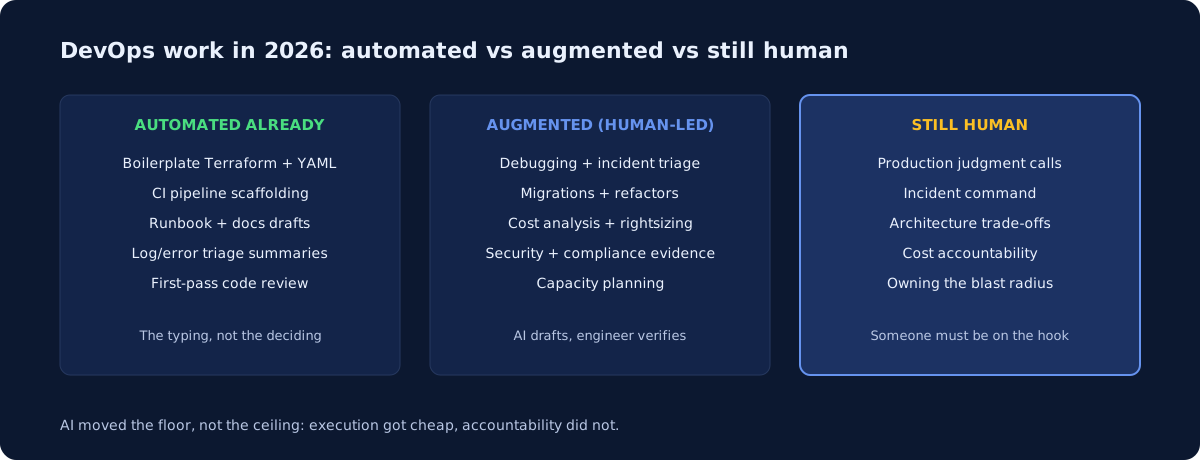
No — but the job is changing faster than most job descriptions admit. As of 2026, AI reliably automates the typing part of DevOps: boilerplate Terraform, CI pipeline scaffolding, runbook drafts, log triage. What it does not do is carry accountability — deciding what’s safe to ship to production, commanding an incident at 2 a.m., or owning a cloud bill. For founders, the practical shift isn’t “skip the DevOps hire”; it’s that a smaller amount of senior time now goes much further than it did three years ago.
What has AI actually automated in DevOps?
The genuinely automated layer is generation and first-pass analysis: work that used to consume hours of a competent engineer’s week and now takes minutes with review. It’s real, and pretending otherwise is how you overpay for infrastructure work in 2026. Adoption reflects it: per Google’s 2025 DORA report, 90% of surveyed practitioners now use AI at work, and more than 80% say it has increased their productivity.
- Boilerplate infrastructure code. Terraform modules, Kubernetes manifests, Helm values, GitHub Actions workflows — assistants produce credible first drafts of all of these. Which tools do it best is a moving target; we keep a current take in our AI coding tools comparison.
- Documentation and runbooks. Drafting a runbook from an existing setup went from a chore nobody did to a ten-minute review task.
- Log and error triage. Summarizing a wall of CloudWatch or Loki output into “here are the three anomalies” is squarely in AI’s wheelhouse.
- First-pass review. AI reviewers catch a real share of mechanical mistakes before a human ever looks at the diff — though they’re a floor, not a replacement for review.
Note what’s common across the list: every item is cheap to verify and cheap to undo. That property, not intelligence, is what determines whether a task gets automated.
Where does AI only augment the work?
The middle band is where AI drafts and an experienced human decides — and this is most of the interesting work. Debugging, migrations, cost optimization, and compliance all fall here, because the failure mode isn’t a bad suggestion; it’s a plausible-looking wrong one applied to a live system. The same DORA research found AI adoption correlates with higher delivery throughput but lower delivery stability — speed without judgment surfaces downstream weaknesses. Its headline framing is worth quoting: AI acts as an amplifier of an organization’s existing strengths and weaknesses, not a substitute for them.
| Task | AI’s role | Why a human stays in the loop |
|---|---|---|
| Incident debugging | Correlates logs, suggests hypotheses | Wrong hypothesis burns your error budget |
| Cloud migrations | Writes conversion code in parallel | Cutover sequencing and rollback are judgment calls |
| Cost optimization | Finds waste, drafts rightsizing | Someone must own the savings-vs-risk trade |
| SOC 2 / compliance evidence | Drafts policies, maps controls | Auditors interview humans, not agents |
| Terraform applies | Plans and proposes changes | State surgery and prod applies need guardrails |
The last row matters most for safety. Letting an agent run terraform apply unattended against production is possible and, in our view, still a mistake without strict guardrails — we lay out the ones that work in Can AI Agents Safely Run Terraform?
What parts of the job are untouched?
Three things, and they’re the three that companies actually pay senior rates for: production judgment, incident command, and cost accountability. None of these are typing problems, so faster typing doesn’t dent them. Practitioners draw the same line themselves: in the 2025 Stack Overflow Developer Survey, 76% of developers said they won’t use AI for deployment and monitoring — the most-avoided task category — and only around 3% highly trust the accuracy of AI output.
Production judgment is knowing that a technically correct change is operationally wrong — that this database migration should wait until after the funding announcement, that this “quick fix” couples two services you’ll spend a quarter untangling. It’s built from having watched systems fail, and models don’t carry your system’s history.
Incident command is a human role by definition. When production is down, someone prioritizes, communicates to customers and the board, and decides when a risky mitigation is worth it. AI is a superb copilot in an incident. It cannot be the accountable party — your customers and your auditors both expect a name.
Cost accountability means someone answers for the bill going up or down — not just spotting waste, but deciding which savings are worth the operational risk and defending that call. Tools surface options; they don’t own outcomes — on AWS, GCP, or Azure alike.
What does this mean for startup hiring?
If you’re a founder with 5-25 engineers: you still need DevOps capability, but AI has changed the shape of the need, mostly in your favor. The junior-heavy model — hire someone to grind out YAML and Terraform full-time — is the model AI actually disrupted, because that grinding is now the automated layer.
What’s left over is senior judgment applied intermittently: architecture decisions, production readiness, incident response, cost and compliance ownership. That’s a poor fit for a full-time hire at typical seed/Series A scale and a strong fit for fractional engagement — the full cost math is in our salary-vs-fractional breakdown, and how the model works day-to-day is on our fractional DevOps page.
Our honest read on the trajectory: AI keeps eating the execution layer, and the accountable-judgment layer keeps concentrating into fewer, more senior people. “DevOps engineer” as a ticket-driven YAML role is genuinely shrinking. DevOps as a discipline — someone accountable for whether production works and what it costs — isn’t going anywhere, and the longer argument for why is in Do Startups Still Need DevOps if AI Writes the Code?
The 2026 verdict: AI replaced tasks, not the role. Hire (or rent) less time from more senior people, give them AI leverage, and keep a named human on the hook for production. If you want an outside read on where your own setup sits on that automated/augmented/human line, that’s exactly what our infrastructure audit is for.
Common questions
Will AI replace DevOps engineers?
No, but the job is changing. AI reliably automates the typing part of DevOps: boilerplate Terraform, CI scaffolding, runbook drafts, log triage. What it does not do is carry accountability - deciding what is safe to ship to production, commanding an incident at 2am, or owning a cloud bill. The practical shift is that a smaller amount of senior time now goes much further.
What parts of DevOps has AI actually automated?
Generation and first-pass analysis: Terraform modules, Kubernetes manifests, Helm values, GitHub Actions workflows, and initial log triage. Work that used to take hours of a competent engineer's week now takes minutes with review. Architecture decisions, incident command, cost ownership, and compliance accountability remain human work.
Should I still learn DevOps in 2026?
Yes, and the judgment layer matters more than the tooling layer. Generating a Terraform module is now cheap; knowing which module is safe to apply, what it will cost, and how it fails is not. Per Google's 2025 DORA report, 90% of surveyed practitioners now use AI at work, which makes reviewing AI output a core DevOps skill rather than an optional one.
Newsletter
One practical DevOps guide a week
Real numbers, honest trade-offs, no vendor fog — same as everything here. Unsubscribe anytime.