Guides · AI & DevOps · ai · ai-agents · guardrails
AI for DevOps: The Complete Guide for Startups
· 18 min read
TL;DR — the short version
- AI is now genuinely good at the generation half of infrastructure work and genuinely bad at the accountability half. Authoring Terraform, drafting runbooks, summarising logs, and first-pass diff review are real wins. Deciding what ships to production, commanding an incident, and owning a cloud bill are not.
- Capability comes in tiers, and each tier deserves a different amount of trust. Autocomplete, chat, read-only agents, planning agents, and applying agents are four different risk profiles wearing similar branding.
- The trust boundary that matters is read vs. write vs. apply, and the default is “plan, never apply.” An agent should propose a diff; a pipeline a human approved should execute it.
- Adoption sequence beats tool choice. For a 5-25 engineer team the order is: assistants in the editor → read-only agent access → agent-authored PRs → gated applies. Skipping steps is how teams get hurt.
- Standardise the config files, the review gates, and the credential boundaries. Leave the prompting style to individuals.
- Measure it or you’re guessing. Google’s 2025 DORA research found AI adoption has a negative relationship with delivery stability even as throughput improves. Track change failure rate and time-to-restore, not vibes.
- The three failure modes we see coming a mile off: agents holding production credentials, generated infrastructure that nobody reviewed, and confidence outpacing verification.
A disclosure before we go further: ByteDel sells fractional DevOps and SRE services, so we have an obvious commercial interest in you concluding that infrastructure judgement is worth paying for. We have tried to stay even-handed — where AI genuinely reduces the need for our kind of work, we say so — but weigh the vendor-neutral sources we cite more heavily than our opinions.
Where does AI actually help in the infrastructure lifecycle?
AI helps most where the work is cheap to verify and cheap to undo, and helps least where the work is a judgement call with consequences. That single property, not model intelligence, predicts almost every success and failure we see. Authoring code, drafting documentation, and summarising telemetry sit firmly in the first category. Deciding whether to fail over a database at 3am sits firmly in the second.
The useful way to think about this is stage by stage, rather than tool by tool.
Authoring infrastructure-as-code
This is the strongest use case, full stop. Terraform modules, Kubernetes manifests, Helm values, CI workflows, Dockerfiles — assistants produce credible first drafts across AWS, GCP, and Azure, and the review-and-correct loop beats typing from scratch. The catch is that a plausible-looking module and a correct one are hard to tell apart at a glance, which is why the output belongs in a pull request rather than in terraform apply. Tool choice matters here more than anywhere else, and it moves fast; our current read is in best AI coding tools for Terraform and Kubernetes work.
Reviewing diffs
AI review is an excellent first-pass filter and a poor last line of defence. It reliably catches convention drift, missing error handling, and the mechanical mistakes a tired reviewer skims past — on every PR, without getting bored. What it misses is the class of problem that depends on context outside the diff, which is most of what makes an infrastructure change dangerous. We compare the current crop, including whether AI should review AI-written code at all, in AI code review tools in 2026.
Triaging incidents
Read-only agents are genuinely useful during an incident and genuinely dangerous with write access. Correlating logs, digging through Kubernetes events, and explaining what changed in the last hour is work an agent does faster than a human can type. But the agent produces a hypothesis, not a diagnosis, and acting on a confident wrong hypothesis at machine speed is how a warning becomes an outage. The RBAC shape that makes this safe is covered in can an AI agent manage your Kubernetes cluster?
Writing runbooks and documentation
Under-rated, and close to free. Drafting a runbook from an existing Terraform module or Helm chart went from a chore nobody did to a ten-minute review task, and the same applies to architecture notes, onboarding docs, and post-incident write-ups. The failure mode is subtle: a runbook that is 90% right is more dangerous than no runbook, because someone will follow it at 3am. Treat generated runbooks as drafts that need one real rehearsal before you trust them.
Cost analysis
AI is good at finding candidates and bad at making the call. It can sift billing exports across AWS, GCP, and Azure and surface idle resources, oversized instances, and forgotten environments far faster than a human trawling the console. What it cannot do is decide whether that “idle” cluster is actually your disaster-recovery capacity. Someone still has to own the trade.
On-call judgement
This one is essentially untouched, and we’d argue it is the clearest boundary in the whole map. Practitioners agree: in the 2025 Stack Overflow Developer Survey, deployment and monitoring was the task category developers were least willing to hand to AI — 75.8% said they don’t plan to use AI for it, ahead of project planning and predictive analytics. That is not conservatism for its own sake; it reflects that the cost of being wrong is asymmetric.
| Lifecycle stage | What AI does well | What stays human | Verdict |
|---|---|---|---|
| Authoring IaC | First-draft modules, manifests, pipelines | Module design, blast-radius review | Strong yes, behind a PR |
| Reviewing diffs | Convention drift, mechanical bugs, every PR | Design flaws, context-dependent risk | Yes, as a first pass only |
| Incident triage | Log correlation, hypothesis generation | Diagnosis, mitigation, comms | Yes, read-only |
| Runbooks and docs | Drafts from real config, fast rewrites | One rehearsal before you trust it | Yes, cheap win |
| Cost analysis | Finding waste across clouds, drafting fixes | Savings-vs-risk trade, approval | Yes, human decides |
| On-call judgement | Summarising what changed | Command, escalation, the call itself | No — keep it human |
| Production applies | Producing and explaining the plan | Approving and executing the change | No — pipeline executes |
The broader question of what this does to the DevOps role — and whether you should still hire one — has its own answer in will AI replace DevOps engineers? The short version there: the typing got cheap, the accountability did not.
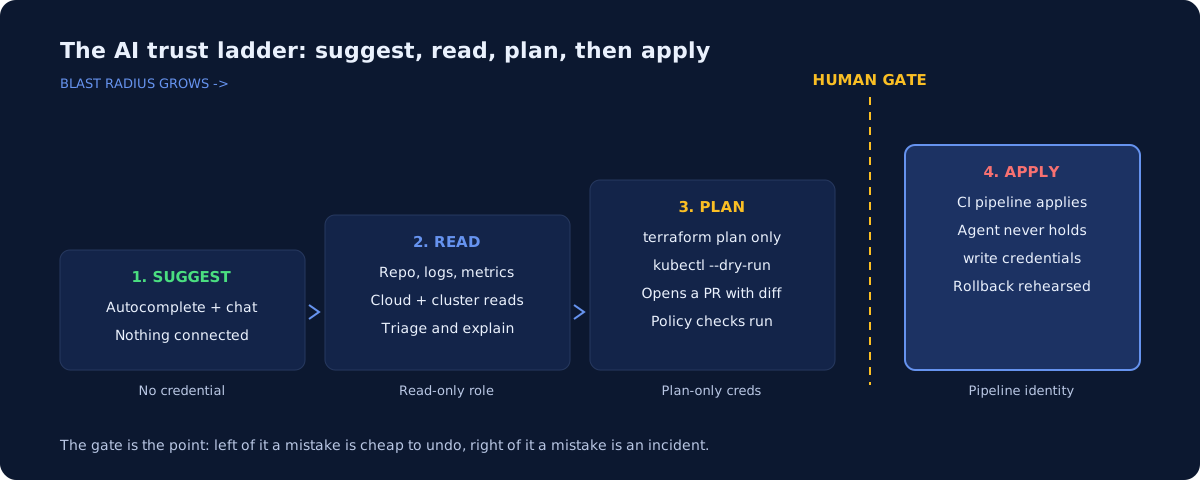
What are the tiers of AI capability, and what should each be trusted with?
There are four practical tiers, and the mistake teams make is treating them as one product because they ship under the same brand names. The tiers differ by what the tool can reach, not by how clever the model is. A chat window with no credentials and an agent holding a cloud role are separated by an enormous risk gap even when both are “AI”.
Work up the ladder deliberately. Each tier should earn the next.
| Tier | What it is | Access it needs | Trust it with | Blast radius if wrong |
|---|---|---|---|---|
| 1. Suggest | Autocomplete, inline chat | Your editor buffer | Boilerplate, syntax, explanations | Nothing — you review before saving |
| 2. Read | Agent with read-only tools | Repo, logs, metrics, read-only cloud/cluster | Triage, “what changed?”, cost sweeps, doc drafts | Information disclosure, wasted time |
| 3. Plan | Agent that proposes changes | Above, plus terraform plan / --dry-run |
Branch commits, PRs, migration sweeps, policy-checked plans | A bad PR — caught by review and CI |
| 4. Apply | Agent that triggers execution | A pipeline identity, never its own creds | Nothing, until a human approved the diff | An incident |
Tier 2 is where most of the durable value lives and where most teams under-invest. Wiring an agent into cloud and cluster read APIs — usually via MCP servers — is what turns a code assistant into something that understands your actual environment. The security model there is unremarkable in the best way: treat the MCP server like any other workload identity, with a scoped credential and an audit trail. AWS’s own MCP documentation frames the managed offering around IAM-based permissions and CloudTrail audit logging rather than tool-specific controls, and the Azure and GCP equivalents inherit Entra ID and IAM roles the same way. The full wiring guide is in MCP servers for AWS and Kubernetes.
Tier 3 is where the newer agent platforms compete hardest, including entrants worth watching but not yet worth standardising on — we took an honest first look at one in Google Antigravity for DevOps work. It is also where fan-out pays: wide, shallow migrations like provider upgrades across thirty modules parallelise well precisely because each unit is small and independently reviewable. That pattern, and where it breaks, is in using parallel AI agents for infrastructure migrations.
Why is “plan, never apply” the right default?
Because a plan is a proposal and an apply is a consequence, and only one of those can be reviewed after the fact. An AI agent should never hold credentials that can mutate your production cloud. It should hold read and plan permissions, produce a diff, and hand that diff to a pipeline that a human approved. The agent proposes; the pipeline disposes.
This is not AI-specific paranoia — it is the separation of duties you would apply to any automated actor. What is AI-specific is that agents fail differently from scripts: a script fails loudly and identically every time, while an agent fails plausibly and variably. The output of a broken script looks broken. The output of a confused agent looks like a reasonable change.
Three concrete boundaries follow from this:
- Credentials. The agent gets a read-only or plan-only role. Write credentials live in CI, bound to an OIDC-issued short-lived identity, not in the agent’s environment or a developer’s
~/.aws/credentials. - Policy. Every plan runs through automated policy checks before a human ever reads it, so the obviously-catastrophic diffs never reach a reviewer’s attention budget.
- Approval. A human approves the diff, and the approval is what triggers execution. The agent cannot self-approve, and the reviewer must be able to understand the diff — a 4,000-line generated plan is not reviewable and should be broken up.
The Terraform-specific version of this, including sandbox accounts and policy-as-code, is in can AI agents safely run Terraform? The CI-specific version — least-privilege runners, cost caps, prompt-injection defences on public repos — is in Claude Code in CI: a hardened GitHub Actions setup.
One honest caveat: this default is conservative. If your entire production estate is disposable and rebuildable from code in minutes, the cost of a bad apply is genuinely low and you can loosen the gate. Most funded startups with paying customers are not in that position, which is why we recommend the strict version until you can prove otherwise.
How should a 5-25 engineer team actually adopt this?
In sequence, over roughly a quarter, with each step earning the next. The most common failure we see is teams jumping to tier 3 or 4 because a demo was impressive, without the review gates and credential hygiene that make those tiers survivable. The order matters more than the tooling.
A practical sequence:
- Weeks 1-2: assistants in the editor. Everyone gets a licensed, company-managed account on an approved tool. The only rules at this stage are secrets hygiene and no personal accounts. This is low-risk and buys immediate value.
- Weeks 3-4: agent config files. Write one canonical rules file describing your stack, conventions, and forbidden actions. This is the highest-leverage hour you will spend, because it fixes the same class of mistake for everyone at once.
- Weeks 5-8: read-only agent access. Wire MCP servers or equivalent to a dedicated read-only cloud identity and a read-only kubeconfig. Use it for triage and cost sweeps. Watch the audit log for a fortnight before going further.
- Weeks 9-12: agent-authored PRs. Let agents open branches and PRs for real work — provider upgrades, deprecation sweeps, runbook drafts. Every PR goes through the same review and CI gates as human work. No exceptions for “it’s only a small change”.
- Only then: gated applies. A pipeline applies after human approval. The agent never holds the credential.
If your product itself was largely AI-built, there is a prerequisite step before any of this: making that stack production-ready in the first place. The auth, secrets, backup, and monitoring gaps that AI-built apps ship with are catalogued in making a vibe-coded app production-ready, and the question of who actually owns an AI-generated stack once it is running is answered in who runs the infrastructure an AI assistant wrote?
What should you standardise, and what should you leave to individuals?
Standardise anything where inconsistency creates risk or review load; leave everything else alone. The line is simple: if a colleague has to trust it, standardise it. If it only affects one person’s keyboard, don’t. Teams that over-standardise get shadow usage on personal accounts, which is worse than the inconsistency they were trying to prevent.
Standardise:
- Agent config files. One canonical, tool-agnostic rules file with thin per-tool adapters, so you get one source of truth rather than three files drifting apart. The layering that works — including what IaC-specific rules belong in there — is in AGENTS.md vs CLAUDE.md vs Cursor rules for teams.
- The approved-tool list and the accounts. Company-managed, reviewed as subprocessors, with the data-retention terms in writing.
- Review gates. The same required reviewers, required checks, and policy checks apply to agent-authored PRs as to human ones.
- Credential boundaries. Who may hold plan-only creds, who may approve applies, and what the agent identity is allowed to reach.
Leave to individuals: prompting style, whether they prefer an editor-first or terminal-first tool, how much they lean on autocomplete, and their personal workflow. Mandating those buys you nothing and costs you goodwill.
What changes for security and compliance?
Less than teams fear, and in a different place than they expect. AI coding tools are subprocessors that touch your source code — the governance question is the same one you already answer for your CI provider or error tracker. Nothing about AI requires a new compliance framework; it requires you to apply the existing one honestly. The teams that stumble in an audit stumble on shadow usage, not on the tools themselves.
Three things genuinely change:
- Secrets exposure surface grows. Assistants read your working tree, and ignore rules have documented gaps. The layered answer — context exclusions, runtime secret injection so nothing sensitive is on disk, and scanners in CI as the backstop — is in how to keep secrets out of AI coding tools.
- Auditors now ask. Vendor review, an approved-tool policy people actually follow, and evidence you can hand over during fieldwork. What SOC 2 auditors specifically ask about these tools is in are AI coding assistants SOC 2 compliant?
- Some teams have a hard data-residency constraint. If a contract or regulator forbids sending code to third parties, self-hosting is on the table — but it is a narrow case, and for most funded startups a cloud API under a zero-data-retention agreement is the better middle path. The trade-offs are in self-hosted LLM coding assistants: when they make sense.
Everything else is the infrastructure security you should already have: least privilege, short-lived credentials, audit logs you actually read. Our general approach to that layer is on our security page.
How do you know if AI is actually helping?
By measuring outcomes rather than asking people how they feel, because the gap between the two is well documented. The honest starting position is that AI’s effect on delivery quality is contested, not settled — and a team that assumes benefit without measuring it is making an act of faith, not an engineering decision.
Two independent sources should give you pause about self-assessment. Google’s 2025 DORA report, based on responses from nearly 5,000 technology professionals, found that 90% of respondents use AI at work and more than 80% believe it has increased their productivity — while also finding that AI adoption continues to have a negative relationship with software delivery stability, even as its relationship with throughput turned positive. Its framing is worth quoting: AI acts as an amplifier, “magnifying an organization’s existing strengths and weaknesses.” Separately, a 2025 METR randomised controlled trial of 16 experienced open-source developers across 246 real issues found participants took 19% longer to complete tasks when allowed to use AI tools — while predicting a 24% speedup beforehand and still believing they had been sped up by roughly 20% afterwards. METR is explicit that this does not generalise to all developers or settings, and you should not read it as “AI doesn’t work.” Read it as: self-reported productivity is not evidence.
So measure these four, before and after:
| Signal | What to watch | Why it catches AI-specific problems |
|---|---|---|
| Change failure rate | Share of deploys causing degradation or rollback | The clearest early warning that generated changes are outrunning review |
| Time to restore | Median minutes from alert to service restored | Rises when nobody understands the infrastructure well enough to debug it |
| Review load | Reviewer-hours per merged PR; PR size distribution | If AI moves the bottleneck to review, throughput gains are illusory |
| Deployment frequency | Deploys per week | The gain AI is supposed to deliver — confirm it actually appeared |
Take a baseline before a rollout. If change failure rate and time-to-restore hold steady while deployment frequency rises, AI is helping. If change failure rate climbs, you have bought speed with stability — exactly the pattern DORA describes — and the fix is stronger control systems, not less AI.
What are the honest failure modes?
Three, and they account for nearly everything that goes badly. None of them are exotic model failures; all of them are ordinary operational mistakes made faster.
Agents with production credentials. The single highest-severity failure mode, and the easiest to prevent. It usually happens by accident: someone points an agent at whatever credential was already in their shell, which is often an admin role. There is no clever mitigation once that has happened — an agent with write access to production has the blast radius of the credential, not the blast radius of its intent. Scope the credential, and the problem disappears.
Unreviewed generated infrastructure. The slower, more common failure. Nobody skips review deliberately; it erodes. An agent opens ten small, tidy PRs, they all look fine, the reviewer starts skimming, and six months later the team has infrastructure nobody can explain during an incident. The tell is time-to-restore rising while everything else looks healthy. The defence is unglamorous: PR size limits, reviewers who genuinely read the diff, and a policy that generated infrastructure gets more scrutiny than hand-written, not less.
Confidence outpacing verification. The hardest to see from inside, which is why the METR result above matters more than its sample size suggests. Fluent, well-structured, confidently-explained output feels verified when it has only been articulated. The Stack Overflow 2025 survey found the leading frustration among developers was AI solutions that are “almost right, but not quite” — the precise failure shape that slips past a skim. The countermeasure is structural rather than attitudinal: make verification cheap and automatic — terraform plan in every PR, policy checks that fail the build, tests that run whether or not anyone remembers — so that verification does not depend on a reviewer’s alertness at 5pm on a Friday.
Where should a startup team start this month?
Start at tier 2, not tier 4. Give everyone a managed assistant account, write one agent config file, wire a read-only cloud identity, and watch the audit log for a fortnight before you let an agent open its first PR. Take a baseline of change failure rate and time-to-restore before you begin, because you cannot evaluate what you did not measure first.
If you want an outside read on whether your current setup can survive agent-authored changes — credential scoping, review gates, policy checks, rollback paths — that is roughly what our infrastructure health check covers. If the answer is that you need ongoing senior judgement rather than a one-off review, hiring a fractional DevOps engineer is the model we offer for teams of this size, and our pricing is published so you can compare it against a full-time hire without a sales call.
To restate the bias we opened with: we sell this work, so treat our recommendation to keep a human in the loop as an interested opinion. The vendor-neutral evidence — DORA on stability, METR on perceived versus actual speedup, Stack Overflow on where practitioners themselves draw the line — points the same direction, and that is the part worth weighing. If you’d like to talk through where your team sits on the ladder, get in touch.
Common questions
What is AI for DevOps?
AI for DevOps means using language models and agents for infrastructure work: generating Terraform and Kubernetes config, reviewing infrastructure pull requests, triaging logs and failing rollouts, and automating recurring platform chores. In practice it works as a trust ladder - suggest, then draft, then apply - with a human gate before anything reaches production.
Are AI agents safe for production infrastructure?
Read access is safe and useful today. Write access needs guardrails: staging first, verb allowlists, GitOps for anything declarative, and a human approving anything imperative. The controlling question is blast radius - if an instruction reaching the agent is wrong or hostile, what can its credentials actually do? Least privilege is the real defence, not prompt wording.
What is AI infrastructure automation?
Automating infrastructure tasks with AI agents rather than fixed scripts - an agent that reads a failing pipeline and proposes a fix, or drafts a migration across many stacks. The difference from traditional automation is that the output is a proposal to review rather than a deterministic action, which makes review gates more important, not less.
Newsletter
One practical DevOps guide a week
Real numbers, honest trade-offs, no vendor fog — same as everything here. Unsubscribe anytime.